If you or your kids aren’t ready for snow sports, winter walks in the Swiss alps are a great alternative. Mountain resorts groom the snow on winter trails so you only need regular walking shoes instead of snowshoes.
Below I explain what to expect and include links to a suggested winter trails we’ve done as a family. See also Snowshoeing in Switzerland.
What is a Swiss winter trail
In general, a Swiss winter hiking trail means that the snow is groomed with a machine (as shown below), so it is relatively smooth and walkable with regular shoes, not snowshoes. See a video demonstrating how the Swiss maintain a winter trail.

The path condition can vary based on the temperature and snow conditions. Trails at smaller resorts and local hills are not necessarily groomed every day. If the trail is not groomed every day, it can get wet and mushy from all the walking and freeze over at night becoming icy.
We suggest using hiking sticks, preferably with snow baskets, for stability. You may also want to bring traction cleats, which stretch over normal shoes and have little spikes to help you not slip on the ice.
Winter trail signs and markers
Winter trails are typically marked with pink trail signs, as shown below, and painted poles that stick up out of the snow (helpful if there is fog). Sometimes the signs have an icon to differentiate between a groomed walking trail and a snowshoe trail.

In my experience, there is a lot of variation with winter trail signs: color, style, info provided. But still helpful and generally easy to understand.
What to wear and bring on a winter hike
You should check the forecast and dress appropriately to the weather conditions. It’s best to bring layers so you can easily adjust your body temperature with changing conditions.
On top, I usually wear a thin long sleeved shirt, a fleece jacket and medium weight down jacket. I wear thick hiking pants, thick wool hiking socks, and waterproof ankle hiking boots. I bring a warm beanie cap and gloves.

If the weather is sunny, we get warm enough while hiking to remove most layers. But if we stop for even a couple minutes, we get cold fast and need to bundle up again.
For more details, see What to wear and pack for a winter hike
Winter trail etiquette
Sometimes the winter trail crosses a ski slope. Although usually signs tell the skiers to slow down and watch for hikers, do not count on it. Wait for a break in skiers, then move with purpose and caution, continually looking uphill for oncoming traffic.
Sometimes the walking trail crosses or shares some sections with the cross country skiing path. In this case, do not tread in the cross country tracks (which ruins them) and keep an eye out for fast skiers that need to pass.
In the pic below, the signs indicate the walkers are not allowed on the cross country skiing path (marked green).

Where to find winter trails
Switzerland has a huge network of winter trails. You can see 60+ official winter trails on SchweizMobil.ch. In addition, each mountain resort usually has more winter trails that are promoted on their regional websites and brochures. For example, Aletsch Arena has 72km of groomed winter walking trails.
AdLooking for the best online services?
Explore top-rated platforms and secure your discount before it expires.
If you are planning a winter holiday and hiking is a priority, make sure to review the number and variety of winter hiking trails before selecting your destination.
When you look at a winter piste map, the winter walks are typically marked in pink or purple. Some maps show a solid line for groomed trails and dotted for snowshoe trails. Usually there is a little icon with a walking person.
The example below from Aletsch Arena shows purple lines for walking trails, dotted for snowshoe, and pink for sledding.

Map of suggested winter hikes
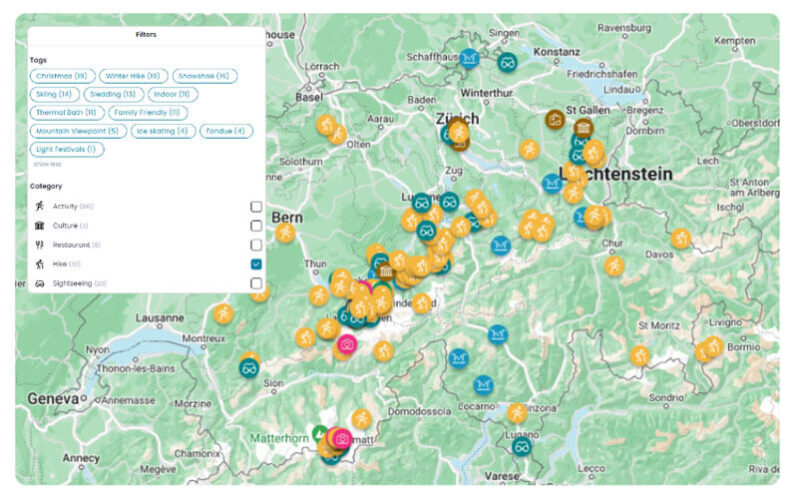
We’ve done many winter hikes near Zurich and Lucerne. Click on the markers to view summary of the hike and link to trail info.
See also Best winter hikes near Zurich and Best winter hikes near Lucerne.
Lower elevation winter walks near Zürich
If we get snow in Zürich, there are a lot of nice free winter walks close to the city. These trails aren’t always groomed but enough people walk on them, that the snow gets tamped down enough that it’s walkable with regular hiking shoes.

See our list of Easy Nature Walks near Zurich and Free Winter Hikes near Zurich (no gondola)
How to pick an easy winter hike
If you are new to hiking, it can be difficult to know what makes a hike “easy.” First, select a hike around 3-5 km long, which should take you about 60-90 mins, walking at a moderate pace. This is a good distance to test your stamina.
Second, choose a hike with under 200m elevation gain, which will reduce the amount of difficult up hill climbs on the hike. Third, look at the elevation profile (example below) and choose trails that mostly flat or have a gentle rolling ups and downs.
If all the elevation gain is in a short distance, this makes for a steep climb that can be strenuous even if is short and the total gain is not extreme. If the all the descent is over a short distance, it can be difficult to not slip on the snow and you might have a lot of pounding on the knees and toes.
Lastly, choose a hike with a mountain restaurant in the middle, so you can optionally take a break inside, warm up and hydrate.
Tips for winter hiking with children
With small children, you could use a stroller on the snow with wide all-terrain tires. If the weather is too warm, the snow can get mushy and rutted, making it difficult to push the stroller. Check the conditions of the trails before committing to bringing a stroller.
Swiss families often pull children along on a big wooden sled, equipped with a chair and insulated sleeper bag to keep your little one all snug and warm.



One Response
Thanks for sharing this helpful information. You are inspiring me for walking in winter. I’m sure most people can take notes from this article. One thing most people lack experience while walking in winter. Well, this post gives us some good ideas for walking in winter.