Dressing and packing for a winter hike or snowshoeing is similar to a regular hike, with a little extra to deal with the cold, snow and ice. It’s important to prepare for a variety of conditions to keep your and your family comfortable, warm and safe.
So here is a list of all the clothing, accessories and gear we typically use on a winter hike. I hope you find this helpful.
Everything I suggest here is for an average winter hike or snowshoe trail in dry, fair winter conditions (around 0 to -10 C).
If you are exploring in deep snow in much colder temperatures, you’ll need warmer, more technical clothing, which I’m not addressing here.
Clothing for a winter hike
Dressing for a winter hike can be a little tricky. You’ll be tempted to dress very warmly. But as soon as you start walking, especially if you are climbing a hill, you will get very warm and sweat, often needing to remove your outer jacket even on a cold day.
But when you aren’t working as hard or taking a break, your body temperature can quickly drop and you will need to add one or more layers to stay warm. So the right kind of layers are important for comfort and temperature.
Here are some suggestions.
1. Winter hiking pants
For a winter hike in dry, fair weather winter conditions, you would ideally wear softshell winter hiking pants that are wind and water resistant, accompanied by a thin thermal base layer.
Unlike ski pants, softshell pants are thinner, breathable and more flexible, which makes them more comfortable for walking.

Some softshell pants are designed more for colder temperatures, with insulation or fleece lining. I have Vaude Badile Winter Pants, which I really like. They are lightly insulated so I don’t usually have to wear thermals and the internal gaiter keeps all the snow out.
You could wear ski pants for a winter hike, but they can be a little bulky and hot, especially for uphill climbs.
On sunny days, I’ll wear thick running leggings which are warm enough. But you must wear gaiters to keep the snow out of your boots.
I’ve also worn jeans with a thin thermal layer or summer hiking pants with a thick thermal layer, which seems to be the right amount of warmth for sunny winter hike. In these cases, make sure to wear tall gaiters to keep the snow out of your shoes.
2. Thermal leggings (aka Funktionwäsche)
Unless you are wearing running leggings, you’ll want a base layer under your snow pants. If you already have thermals for skiing, use those. My boys have the Odlo Active Warm Kids set, which has served them well for skiing and winter walks.

Thermal layers usually come with a warmth rating. For snowboarding, I like a thick thermal to keep warm while sitting on the chair lift. But for a winter hike, I like a lighter thermal because I get so warm and sweaty on the climbs.
As for materials, I like Merino wool, which is very soft as well as naturally breathable and warm. But some prefer sporty synthetic materials (particularly if you are vegan) that are designed for moisture wicking and cooling. Synthetic materials also tend to fit tighter, giving more support, which may be important to you.
Every sport store in Switzerland sells thermals, usually popular brands like Odlo, Ice Breaker, UYN. Big box stores have their house brands like 46 Nord, Trevolution and Quechua, which are slightly less expensive.
If you want to shop local, you might look at the Lovely Sheep online shop, a small family business which sells Merino wool thermals. Thermals can be very expensive, so definitely take advantage of the January sales.
3. Base layer long arm shirt
Many like to wear a thermal top (see advice about thermals in the above section). But I just wear a thin long-sleeve running top. So far I haven’t felt the need to have anything more technical than that. Sometimes my kids just wear any old long sleeve T-shirt, they aren’t picky.
The base layer should be moisture wicking, so when you sweat, the shirt doesn’t soak in the moisture and make you cold later. Best to keep this base layer thin and add warmth with layers.
4. Mid-layer fleece jacket
I always bring a fleece jacket as an optional mid-layer in case I get cold. I don’t always need it, but I’m always thankful to have it.
Fleece jackets have a “weight”, which indicates how warm they are: 100 being the lightest, 300 the heaviest. I have a 150 Jack Wolfskin fleece, which is a great layer for sporty activities, but not quite warm enough if I’m just sitting around camp on a cold night. (Learn more about fleece).
For a winter hike, I would pick a midweight fleece that is slim enough to fit under your outer layer.

5. Outer layer jacket
I’ve done winter hikes in my ski jacket but I always regret it because it’s much too hot, only necessary if you are in some seriously cold, bad weather. Instead, I wear a lightweight down jacket that is packable, meaning it compresses quite small so I can easily fit it in my backpack. It’s not super warm but is an excellent layer while hiking.
Down jackets from popular brands can be ridiculously expensive (CHF 300-600). I have no idea if those are truly better than less expensive models. I currently use a TOG24 jacket with synthetic down and an inexpensive down jacket from Decathlon that works surprisingly well.
Down filling has a “fill power rating”, which indicates the quality of the down, not necessarily how warm the jacket is. Learn more about down fill power.
If you prefer not to use animal products, many companies, including TOG24, make jackets with synthetic down, which has similar properties but not quite as warm or compressible as down.
I also often pack my water and windproof rain jacket, if I expect wind or snow, just in case. But so far, I’ve never needed it.
Shoes for a winter hike
6. Hiking boots
Best to wear a sturdy waterproof hiking boot for winter walks and snowshoeing, with a high ankle that help keep out the snow. A soft, flexible snow boot is ok for a short walk, but it won’t give you the support or comfort you need for a longer hike.
I wear these Meindl Air Revolution Ultra hiking boots (blue/grey below), which are very waterproof. My kids don’t have ankle hiking boots, so for snowshoeing they have been wearing their casual winter boots (black below), which are quite flexible and soft, not hiking shoes at all. They don’t seem to mind. I went on an short, easy snowshoe walk with my casual winter boots and it was ok and definitely warmer and more cozy. But I missed the sturdiness of my hiking boots. It just wasn’t quite as comfortable hiking on uneven terrain.

7. Warm hiking socks
You’ll want a thicker sock than you use in summer, like a thick wool hiking sock or technical ski sock. I recently bought some inexpensive hiking socks from Decathlon and they are my favorite socks at the moment.
8. Insoles
You can add insoles to your hiking boot to add warm and comfort. I use a gel cushion insole in my boots, which also seem to help with insulation. You can also buy felt insoles specifically designed for warmth, like these felt insoles from Decathlon.
9. Gaiters
Even with tall hiking boots, you’re likely to kick up snow into your boot as you walk. That snow melts and drips into your socks, making your feet cold and wet. So best to protect your feet by wearing gaiters, which are a waterproof fabric that wraps around your calf, ankle and shoe like a leg warmer.
Most gaiters have a strap that goes under your shoe. Make sure this secures well so you don’t trip on the strap. Some cinch under your knee so they don’t fall down. Make sure it’s not too tight, which becomes very uncomfortable while walk, or too loose, which is annoying as it continually falls down.
We have a pair from Outdoor Research brand, which is good quality and easy to use. I like that it stands tall without having to cinch tightly around my calf. I bought Tatonka brand for my kids, which have elastic around the ankle and calf. They worked well for some rainy, muddy hikes in the UK. I find this elastic style uncomfortable, but my kids didn’t mind them.
SponsoredDiscover top exclusive offers today!
Click here to learn more and take advantage of these limited-time deals.

10. Traction cleats
Official winter trails in Switzerland are typically groomed with a machine so you only need hiking boots, not snowshoes. However, these snowy trails still often have icy, slippery parts that can make walking difficult, even dangerous. So traction cleats can make walking on snow much easier and safer, even just for walking around town after a snow storm.
Traction cleats strap on to the bottom of your boots, usually with some sort of stretchy elastic or silicone with little pointy spikes or textured chains on the bottom. A few of my friends recommend YakTraks Diamond Grip (shown below). This brand has a variety of models for different conditions.

For snowshoe recommendations, see How to snowshoe in Switzerland for beginners
Accessories
11. Gloves
You can wear any kind of glove that keeps your hands warm. You don’t need to worry as much about waterproofing as you do for ski gloves because you probably won’t be falling down in the snow. Instead of thick ski gloves, I usually prefer a thinner running or biking glove (preferably windproof like these). But it’s all a matter of preference.
While I’m walking, I usually find that I’m warm enough that my hands don’t get that cold and just need a thin layer to protect from the elements.
On sunny winter days, sometimes I don’t even wear gloves. But if we stop moving or the weather turns worse, my hands are often the coldest part of my body, especially because I’m gripping poles and I can’t stuff my hands in my pockets.
I’m always losing gloves; I have probably a dozen single gloves floating around the house. So I typically buy inexpensive gloves that don’t make me upset when I lose them.
12. Hat
I always bring a warm winter beanie but I often take it off a few minutes into the hike because I get too warm. If it’s sunny, I prefer a ball cap with a long bill to keep the sun out of my eyes.
I usually bring both types of hats in my backpack in case conditions change.
13. Sunglasses & sunscreen
The sun is more intense when reflecting off the snow. So don’t forget sunglasses and sunscreen to protect your eyes and face, even on a partly cloudy day.
On one winter walk, it was so bright my son couldn’t even open his eyes. So we had to buy overpriced sunglasses from the gift shop.
14. Scarf or neck warmer
I usually bring a neck warmer in case the wind picks up. But I rarely wear it during the hike. A neck warmer is much smaller to pack than a scarf.
Basic Equipment
15. Poles
I always bring poles on a winter walk. Even if the path is well groomed, you will encounter conditions that will be easier and safer to cross with the stability you get with poles: uneven terrain, icy spots, soft snow that breaks through the surface. Many people simply use their ski poles. If you use summer hiking sticks, buy the snow basket attachment if possible. Otherwise, your poles will often sink too far into the snow to be helpful.

Last Christmas, I received these wonderful Lexi Micro Vario hiking sticks, which I adore! I added snow baskets for this winter and they work perfectly.
16. Backpack
You’ll want a backpack to carry water, snacks and your layers. I usually just take my smaller day pack I use for summer hikes.
17. Mini Sled
If you are hiking up, it might be more fun to sled down. In fact, some trails in Switzerland are designed exactly for this, with a loop intended for hiking up one side and sledding down the other.
If you don’t want to drag a full sized sled, I suggest a lightweight shovel style sled (shown below) that can easily fit inside a backpack.

18. Sit pad
If you do need to take a break, you’ll want an insulated sit pad to keep your bottom dry and a bit warmer than sitting directly on the snow. I prefer the egg carton style but it is a bit bulkier than the sleeves with metallic material.

Food & Water
Since you probably won’t want to sit in the cold and eat a picnic, bring snacks for on-the-go and perhaps plan your hike with a mountain hut along the way to warm up inside with some hot drinks and food.
19. Water
Bring at least a liter of water per person, or more depending on how far you hike. You may want to use a water bladder with a straw so you don’t have to fuss with a water bottle with cold fingers. If it’s very cold, your water could freeze. So you may want to carry it in a insulated container.
20. Thermos with hot drinks
A nice hot chocolate or tea can not only lift the spirits of any hiker, but also warm up your hands and belly.
21. Snacks
Bring high energy snacks to refuel as you hike. Even if you are walking a relatively easy flat trail, walking on snow can take more energy than you think. I bring energy bars for me and candy for the kids.
22. Cash
Many winter trails lead to a mountain restaurant, where you might want to take a break and get some refreshments. Some only take cash, so bring some just in case.
Safety Supplies
23. First Aid Kit
You should carry a basic first aid kit with all the normal stuff, like band-aids, disinfectant, elastic bandage for sprains, etc.
24. Emergency blanket
Most official winter trails in Switzerland are not far from civilization, so you can usually get help quite easily. But if someone gets injured and has to wait even an hour while someone gets help, you need that person to stay as warm as possible.
An emergency blanket is made of a thin lightweight insulated material that radiates the heat of the person wrapped in the blanket. This can mean life or death in some situations. You should always keep this in the bottom of your backpack, even in summer.
25. Phone with GPS enabled
Obviously, you’ll want your phone so you can contact people in an emergency. But since snow trails can sometimes be difficult to see and follow, you should download the trail on your phone for offline use and use the GPS function to identify your location.
This is very helpful if you accidentally take a wrong turn or lose the trail. Since cold temperatures can quickly drain a battery, best to bring a portable charger and cable just in case.
Backcountry Safety
If you plan to explore anywhere away from official trails, you should take an avalanche safety course before heading out. You will learn to use a shovel, probe and beacon that you should always carry with you on these types of adventures.
See the MSR Beginners Guide to Avalanche Safety.
Printable packlist

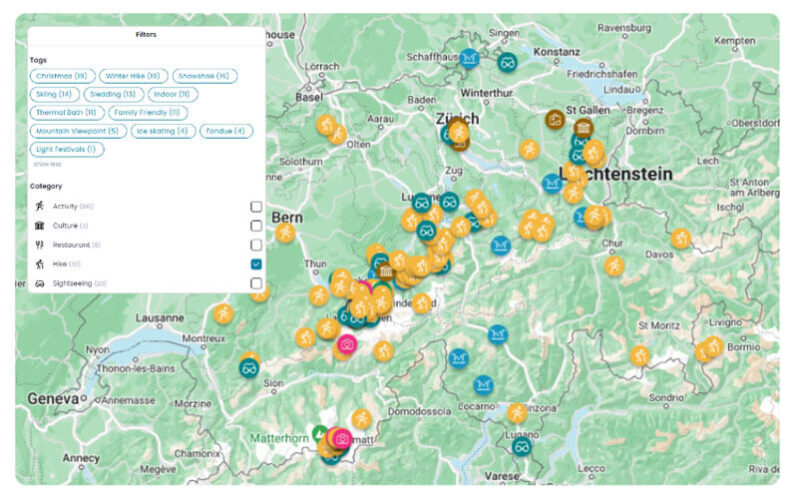
Find a winter trail…




2 responses
Thanks for the wonderful suggestions! I would dearly love to be hiking in the alps this winter, but am stuck with my own local mountains (the US rocky mountains, so I can’t complain too much). My favorite piece of winter hiking gear by far is a SmartWool miniskirt that I bought last year. I’ve found that my legs usually don’t get too cold if I’m wearing appropriate leggings, but the skirt keeps my hips and bottom toasty warm without overheating.
Thanks for this great tip! I’ve seen insulated hiking skirts and I always wondered why. Now it totally makes sense. I’ll have to try one.