We were so excited the first time we found wild blueberries in Switzerland and realized we could eat them. We saw some other hikers gathering something off the side of the trail, which we assumed was mushrooms, which are too risky for amateurs.
Then we realized it was berries, so we dove right in and made a proper mess of ourselves, with purple juice all over our faces and hands. The berries are tiny, so it takes a lot of work to make a handful. But it’s so satisfying and addictive; once we start, it’s hard to stop picking.
Here are some tips and favorite sports for picking wild blueberries in Switzerland.
When & where to pick wild blueberries
The short answer is anywhere at the right elevation during August and September.
So on any alpine hike, keep your eye out and you’ll probably find them. We usually see them above 1600m, right below the tree line.
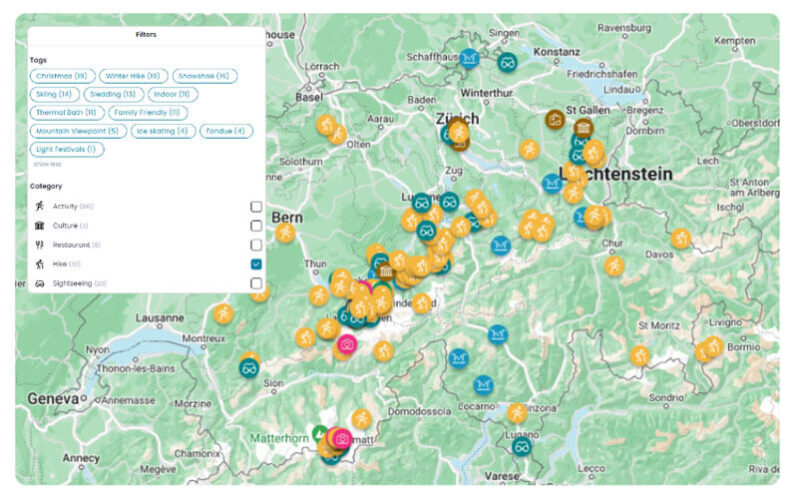
Best to look near lakes, streams and marshy places, but that’s not always the case. Keep scrolling down to see details for all our favorite spots.
To give you an idea of what the blueberry patches look like, the areas in both pictures below are densely covered in blueberry bushes, the leaves green in early August and bright red in late September.

Wild blueberry bushes have tiny thin leaves that turn red as the season progresses. They often grow right next to another plant, with thick waxy green leaves, that also has blue-colored berries, except those ones are not edible.
Make sure to show your kids the difference before picking. Once you see the difference, it’s totally obvious. Both bushes below are blueberry.

Unlike domestic blueberry bushes, wild blueberries are tiny and don’t grow in bunches. To be honest, they can be a little time-consuming to pick because you have to search around the bush for ripe berries and wander from bush to bush to find more. But it’s worth it!
What to bring for blueberry picking
You need a container to collect the berries, most anything will do. The berries are tiny, so you only need a small container. A PET bottle is a good choice because of the narrow opening that helps prevent spills but it’s also harder to get the berries inside.

I usually bring small plastic food containers with a lid, so we can transport the berries back home. For kids, it’s nice if you have something with a handle, so it’s easier to carry.
My kids have several times accidentally tipped over their open containers and spilled all their hard work.
What to do with the blueberries
Note: It’s best to wash wild berries before eating because they could have been exposed to Echinococcus, a rare but serious disease, by foxes. Better safe than sorry.
The kids will probably eat everything they pick (and get it all over their hands and faces). But if you take some home, you can keep them several days in the fridge. Otherwise freeze them. We use the berries on top of yogurt or oatmeal, in smoothies, and in pancakes.

We’ve also used them to stain our walking sticks, which makes for a fun memory. We re-stain them every year to keep the color fresh.

Our favorite spots for picking wild blueberries
Melchsee-Frutt
At Melchsee-Frutt, there are lots of blueberry bushes all along this easy, short walk around the Tannalp lake. The bushes are close to the path, making easy picking for little kids.

The path is suitable for strollers and can be accessed by a little tourist train, so you can minimize the walking if necessary.
Details for Melchsee-Frutt trail.
Gelmersee
This is one of our favorite picking spots. There are blueberry bushes all around the lake, but particularly dense near the waterfalls on the far side of the lake and along the trail on the lake, near the big rock outcroppings.
See details for Gelmersee hike (must book tickets in advance)

You can also pick berries in the valley. From the funicular station, cross the suspension bridge and follow the path to the restaurant. Then head into the woods to the Barfussweg, aka barefoot path.
Discover top exclusive offers today!
Click here to learn more and take advantage of these limited-time deals.
There are loads of blueberry bushes in this area. We took off our shoes and walked barefoot on the soft ground, feeling very one with nature. Then we gathered berries and smashed them all over our walking sticks.

Niederhorn
After enjoying the views on the ridge (left pic below), loop back on the lower trail that dips through the forest (right pic below) before returning to the cable car. The forest has lots of blueberry bushes, particularly in the marshy parts near the streams.
See details for the Niederhorn trail.

Flims Waterway
This long hike starts with amazing views in a high alpine valley plus an enormous waterfall. Then you hike down the river, crossing lots of bridges over gorges.

About halfway down the trail, we found a huge patch of blueberry bushes along the river. We wanted to stay longer to keep gathering and eating, but we were in a hurry to finish before sunset. Boo hoo.
See details for the Flims Waterway hike
Fürenalp
We loved this budget option in the Engelberg area for the views and playground. In late summer, you get the extra benefit of blueberry bushes along the trail, near the restaurant at the top.

You don’t have do the whole 9km trail to get the berries, just the shorter loop at the top. We found some bushes in between the rocks, but you’ll need to explore a bit to find the jackpot.
See details for the Fürenalp trail
Mettmenalp
This alpine lake has lots of blueberry bushes around it. There’s a short path around the lake (no strollers) and longer, more challenging hikes in the hills above the lake.

See details for Mettmenalp hike.
Tiefenbach-Realp
I couldn’t believe how many blueberry bushes were on this trail! All those rust colored areas in the picture below are blueberry bushes.

It’s a little higher elevation here (above 2100m), so the berries here are ready a little earlier than other places and by the end of September, many of the berries were already shriveled. We did this hike as part of a mountain hut stay.
See details for the Tiefenbach-Realp hike
Jucker Farm
If you don’t want to hike and you want to pick lots of berries fast, try the blueberry fields at Jucker Farm, a tourist farm near Zürich.
These are domestic blueberries so they are bigger and grow in big bunches, meaning you’ll fill up your baskets much quicker.

There is an entrance fee to the blueberry fields. They provide small cardboard boxes for gathering berries. More details in my Jucker Farm post
I hope you find lots of berries and make some memories!
Pin this for later…




4 responses
I wonder, how people can mix up blueberries and billberies? They are different species from the same family. All posts of Juker Farm except the last one concern billberies and only the last picture is about blueberries. Both species are easy to distinguish! Do not confuse others!
Wow, I’ve never heard of billberries before. Thanks for letting us know. Now I understand why there are two names in German – Heidelbeeren are billberries and Blaubeeren are blueberries. I love learning new information. Thank you.
Hi, for blueberries, is there a picture of the non-edible ones that are next to the edible ones? Is it poisonous if you eat the non-edible ones?
The non edible ones have waxy leaves. I don’t know if they are poisonous, but I wouldn’t eat them in any case. I’ll look for a pic of the non-edible ones and post it.