
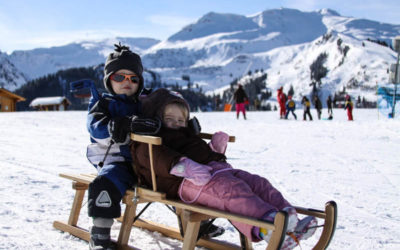
In Switzerland, sledding means racing several kilometers down a mountain, not just a little hill at the local park. Most Swiss ski resorts have dedicated winter toboggan runs with groomed snow, sled rentals on site, and a chair lift or cable car so you can easily ride back up and do it again. These sled runs are fun for all ages and a great choice for non-skiers who want some speed and excitement.
Below I give you all the information you need to get started sledging including what to expect from a sled run, types of sleds, how to steer, what to wear, how to sled with small children and more.
1. What is a Swiss sled run?
Many Swiss ski resorts have a long sled run, aka “Schlittelbahn,” which is a designated sledding route down the mountain with groomed snow. These winter toboggan runs range from 3 to 10 km long, often following a snow-covered road down the mountain. Although many sled runs are suitable for small children and families, some sled runs are very steep and have drop-offs on the side, which can make them dangerous.
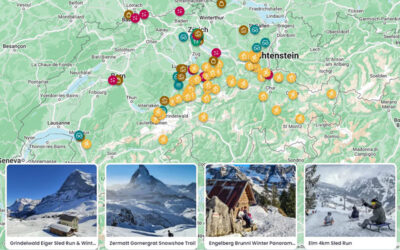
See our list of the best sled runs near Zürich.

2. Prices for sledding
Use of the sled run is free, but you need a ticket to ride the mountain transport to reach the top of the sled run. You can usually pay for a single ride, a multi-pack or day pass, depending on how many times you want to sled. A sledding day pass usually costs about CHF 30-40/adult, discounts for teens and children. A single ride may cost CHF 10 – 15/adult.
3. Renting sleds
Ski resorts always rent sleds, either at the ticket office, lift station or kiosk near the sled run. You do not need to rent sled beforehand at a sports store. On very busy days, they may sell out of sleds.

At most resorts, you rent the sled for the full day, which usually costs CHF 10 – 30. At some resorts, you can also rent for a single ride, multi-pack (e.g. 3 times) or half-day, which matches to the lift ticket you purchase. Many sled rentals only take cash, so come prepared. Some require that you leave an ID as a deposit.
Most ski resorts rent high quality racing sleds with a webbed seat stretched across angled steel runners. These types are very comfortable and easy to maneuver. Sometimes they rent plastic sleds for a cheaper price. More about sled types below.
5. How to ride and control your sled
To ride a racing sled, sit on the back half of the seat, lean back and hold the leash in your hands. On relatively flat areas, you can rest your feet on the front corners of the sled. To turn, lean and pull the leash in the direction you want to go. You can also drag a foot in the snow on the side, which will help you turn more sharply.
To brake, lean back and drag both feet on the snow. On very steep slopes, sit at the back of the seat, hold the top front rails of the sled and pull backward, slightly tilting the sled upwards to brake more dramatically. Some places rent “Bremssohlen” (aka “braking soles”) which are basically low profile traction cleats that fit over your shoes. They create more resistance on the snow as you drag your feet, particularly helpful if the snow is icy. I saw some at Intersport for CHF 29 and advertised for CHF 70 on www.lindauerschlitten.ch. I haven’t used them myself.

For a demonstration, see this alpine sledding tutorial (in German with English subtitles).

6. Buying sleds
Sleds are widely available at all sporting goods stores, like Migros SportXX, Decathlon, and Ochsner Sport. Department stores like Manor and Coop sometimes sell them as well. You can also find sled at secondhand stores (“Brockenhaus”) and online exchanges. See Where to buy and rent winter equipment in Switzerland.
Racing-style toboggans
These racing sleds are the easiest to use and most comfortable. The angled runners make it easier to turn. The flexible webbed seat is much more comfortable than a hard wood seat. These are the most expensive sleds, costing upwards of CHF 300. Many ski resorts rent this sled style.

Davos-style wood sled
The Davos-style wood sled is a Swiss classic, providing smooth ride and decent control. They come in various lengths, from 1 to 3 persons. These are good for an adult riding with a child, especially with the child seat accessory shown below. Riding single, small children may find this heavy sled hard to control with their short legs and do better on plastic sleds with hand brakes. These wood sleds are expensive but last a long time. The Davos brand runs about CHF 250 or more. A Davos-style sled, aka “Davoser-Art,” are less expensive, a single rider version for about CHF 55, a double for CHF 90.

Bob style plastic sled
Many children prefer the plastic sleds with a steering wheel and brakes. I find that they flip over easily when the kids jerk the steering wheel. But they also ride better over jumps. My kids were able to ride together when they were little, the older brother steering.
SponsoredDiscover top exclusive offers today!
Click here to learn more and take advantage of these limited-time deals.

Shovel-style sled
The first sled you should get is the shovel-style sled, aka “Schneerutcher.” We love these because they are light and easy to carry, even fit in a backpack. They give a surprisingly good ride once you pack the snow down. Little kids can use themselves without getting hurt. They also work as a snow shovel for building sledding ramps and snowmen. They only cost about CHF 5 so it’s worth buying one for each kid. You will only use this on small sledding hills, not sled runs.

7. Sledding double with children
If you have very small children, make sure the sled is big enough for an adult and child because toddlers can’t steer these things. Those low profile plastic sleds are a tight squeeze, while the raised sleds are much more roomy, sometimes fitting even three people.

We have also used our wooden Davos sleds, which also have good control and give a smooth ride. I’ve seen kids do this run on cheap plastic sleds with hand brakes, but I tend to flip those quite easily. I recommend that kids ride with adults until about 7 or 8 years old, when they can confidently stop the sled and not slip off the path onto a sleep ski slope.
Whatever you buy, make sure it has a good rope because no kid likes walking back up the sledding hill and your kid will definitely want you to pull them.
8. Sledding with a baby or toddler
Baby sled seats
For toddlers, I recommend the sled chair attachment to a wood sled and the warm sled sack shown below. This is not just for sledding, but also an alternative to a stroller when walking around in the snow. Kids love being pulled around on a sled. If you can afford it, I would get the wood one with the back below sells for about CHF 80. The plastic version sells for about CHF 36. The less sturdy wood chair sells for about CHF 40, which is what I had, functional but didn’t last forever.
Child seats are good for light sledding and walking. But I don’t recommend using child sled seats on extreme long sled runs. You have to twist and turn your body hard as you sled and our child sled seat eventually snapped under the pressure.

Sled sacks
This is just one example of a sled sack for small children, great for winter walks as well as sledding. This one sells at Migros SportXX for about CHF 50. Without a sled sack, make sure to bundle up.

9. What to wear sledding
You should wear the same type of clothing that you would wear skiing, i.e. warm base layers and waterproof outer layers that will keep you dry. For specific tips on winter sport clothing, see How to Dress Your Kids for Skiing.
In addition, here are a few sledding-specific recommendations for your accessories:
Shoes: you should wear waterproof snow boots or winter hiking boots, preferably sturdy boots with ankle support. While sledding, you will use your feet to brake and steer, so there will be a lot of pressure on your ankles. Ankle sprains and breaks are the most common injury for sledding. Snowboard boots are ok for sledding, but not ski boots.
Gloves: You will be using your hands to hold the sled leash and you may drag your hand on the snow to help steer. So warm, waterproof gloves are important for sledding. I would use your ski gloves, not casual mittens.
Helmets: Sledding can be dangerous, so you should definitely wear a helmet, even though many other sledders don’t. Most sled rental kiosks do not rent helmets. So if you need one, you may need to visit a local sport shop instead.
Goggles & buff/scarf: While sledding, it’s common for lots of snow to fly into your face, especially as you drag your feet for turning or braking. So wearing goggles or sunglasses plus a scarf can make your sledding experience more comfortable, especially for a small children riding double.

10. When to go sledding
Before you go sledding, check the snow conditions and ski resort operating status to make sure the sled run is open and lifts running. Since sled runs are usually at a lower elevation that the main resort, they don’t always have enough snow even if the ski resort does. Also, sledding on ice can be unpleasant and dangerous because it’s more difficult to slow down and stop. We prefer sledding on fresh snow or warm day when the snow is soft and slushy.
Bonus: German Sledding Terms
Here are some helpful words and phrases for your sledding day.
- sledding = schlitten or schlitten fahren
- sled run = Schlittlebahn or Schlittelpiste
- sled = der Schlitten or “Bob”
- child seat for sled = Schlittensitz
- Where can I rent a sled? = Wo kann ich einen Schlitten mieten?
- We are going sledding today. Do you want to come along? = Wir gehen heute schlitten. Möchtest du mitkommen?
- I’m sorry! = Entschuldigen!
- Watch out! = Achtung! Pass auf!!!
- Move out of the way, coming through! = Hallo! Geh aus dem Weg bitte. Wir gehen sofort durch.
- I hurt my ankle. I need help. = Ich habe meinen Fussknöchel verletzt. Ich brauche Nothilfe.
I hope you have a great time sledding in Switzerland!





8 responses
Your blog is my number one reference for what to do how in Switzerland, THANK YOU SO MUCH for the incredible detail you put into it and that you keep it updated, your family is defintely lots of fun!!! All the best 🙂
Thanks so much! So glad you are having a good time with the activities you find on my website.
Hi, I found some nice foldable wooden sleds on Amazon:
https://www.amazon.com/dp/B0053G9MXW?m=A1LABXC6H6V68G&ref_=v_sp_detail_page
Super cool! Storing those things is the worst part. Thanks for sharing.
These are great! Bought mine there. Kids love it and the folding system is super handy when traveling.
Glad to know you like them. I was curious if the folding ones would be sturdy enough.
Hi! I would like to ask ypu where i could buy the plastid sled seat. I have been looking in zurich but could not find it. Thanks a lot
I googled “Schlittensitz” and found that Ochsner Sport sells one for CHF 35. I don’t know if they carry it in the stores but you can order it online. https://www.ochsnersport.ch/de/shop/Eko-Schlittensitz-Jenny-silber-00002000876820-p.html Hope this helps!