Rösti is the classic hiking food in Switzerland, a traditional dish of fried grated potatoes often topped with a fried egg, bacon and/or cheese. You’ll find this hearty meal served at many mountain huts and restaurants all year round.
I’ve eaten Rösti on countless Swiss hikes and ski days since moving to Switzerland in 2005. I learned to make it home from my Swiss neighbor, using traditional cooking methods. It’s now a part of our regular meal rotation.
Below I give an easy recipe and explain the Rösti ingredients and cooking methods. The first time I made Rösti, I thought it would be simple but I made rookie mistakes that made it harder than it needs to be. Using my tips below, I hope you can avoid that. As we say in Zürich, en guete!
What is Rösti?
Rösti is a potato dish, where grated potatoes are fried in a pan. Unlike American hash browns which are loosely sautéed, with Rösti, the grated potatoes are compressed into thick “pancake,” which is crisped on each side. Unlike latkes, there is no egg or flour to bind the potatoes.
Rösti is a very common dish served at mountain restaurants in Switzerland, often topped with a fried egg, bacon and/or melted cheese. It is sometimes served as a side dish, for example with bratwurst and onion gravy or sliced veal or pork in a cream sauce (a traditional Zürich dish called “Zürigeschnetzeltes”).

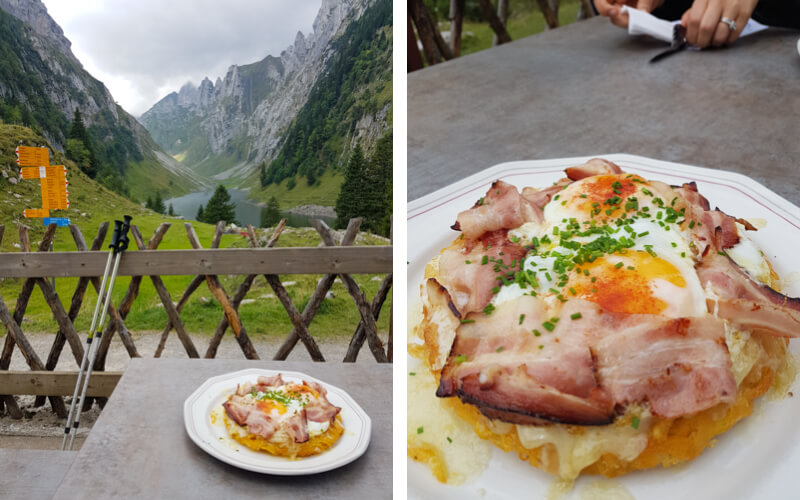
The main reason I cook Rösti at home is to remember all the great meals we’ve had on the trail. The one below was my favorite Rösti of all time served at Berggasthaus Bollenwees along the fantastic Saxer Lücke hike. They deep fry the Rösti to make it extra crispy.
Tips for making Rösti
1. Potatoes for Rösti
It’s best to use an all-purpose potato that’s not too starchy and not too waxy. You need the potato to retain its shape a bit and not dissolve into mush, but not so sturdy that you taste each strand. In the U.S., Yukon Gold is a good option.
In eastern Switzerland, many groceries sell potatoes specifically labeled for Rösti, usually in a red bag (blue is for starchy, green for waxy). If you can’t find this bag, I would use Festkochend (aka waxy) potatoes.

2. Pre-boiling the potatoes
Traditional Swiss Rösti recipes instruct you to parboil the potatoes the night before and cool them overnight before grating them. This process is supposed to help the Rösti cook faster and retain a nice texture.
Since I rarely plan that far ahead, I always grate the potatoes right before I cook them. In my experience, I haven’t noticed a significant difference in the Rösti texture between parboiled potatoes and freshly grated. I suggest doing what works for you and don’t worry about being strictly traditional about this.
3. Grating Rösti potatoes
Most Swiss cooks grate the potatoes by hand on a grater with large holes, called a Rösti-Raffel in Switzerland. I’ve done this many times but I don’t like it. It’s a huge mess as the potato juice runs onto the counter while you grate. And I often scrap my knuckles on the grater as the potatoes get smaller.
Instead, I use the grating feature on my food processor, which makes this task much easier and faster. I think the grate is a little big, but this small compromise is worth the efficiency.
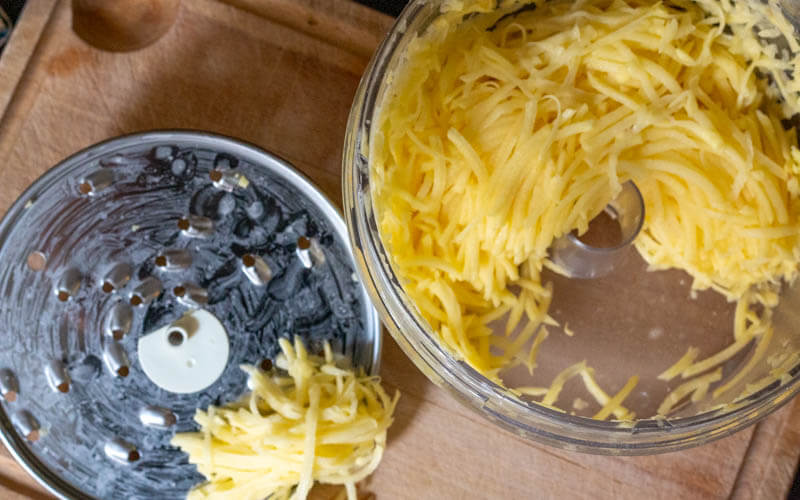
With raw potatoes, it helps to squeeze as much moisture as you can from the potatoes to encourage crisping (thanks Cook’s Illustrated for this helpful tip). I usually squeeze the potatoes briefly with my hands. I’ve also used a potato ricer, which is more effective but also takes more time. That said, I have also made Rosti many times without squeezing the moisture out of the potatoes and it still works.
Before cooking, toss the grated potatoes with salt, about a teaspoon for a full pan. The Swiss do not mix in a binder, like flour or eggs, with the potatoes.
4. Pre-grated Rösti mixes
When I first moved to Switzerland, I was horrified to learn that many of my friends used the par-boiled pre-grated Rösti packs you can buy at any grocery here. After years of judging my friends poorly, I tried the pre-grated Rösti and it’s not nearly as bad as I thought. But it’s still not my first choice as the texture is not pleasant.

With packaged Rösti, you simply cut off one end of the package and squeeze the potato block into your warm pan. You don’t need to add butter or other fat as this is already in the mix. Then you break up the rectangle block, loosening the potato bits from one another, and form into a circle, as you can see in the below photo.

I find it much harder to get these potato shreds to stick together and crisp up because the packaged potatoes are very wet. Very often these pre-packaged Rösti fall apart as I try to flip them, which never happens with my home grated Rösti. Also, since these Rosti mixes are pre-seasoned, I find them quite salty for my taste. So even if grating potatoes myself is extra work and messy, I much prefer the end product.
That said, these Rösti packs are a helpful convenience food and good to have in your pantry for a last minute easy meal. There are many different flavors, often with sausage and cheese included in the mix. But I suggest using the plain versions and add in your own toppings.
5. Use lots of butter!
The key to a crispy Rösti is lots of butter, the more the better. In addition to the initial butter in the empty pan, many Swiss Rösti recipes advise rubbing small pads of butter around the sides of the pan during cooking. I always do this when cooking Rosti and it really helps crisp the edges. I’ve gone through an entire stick of butter this way.
Also make sure to add butter to the pan between the flip, so the second side has enough fat underneath it, not just on the sides. If you don’t, that second side of the Rösti tends to burn instead of getting golden.
If you have clarified butter or Ghee, definitely use it. Since the milk solids have been removed, it tends to cook more golden without dark burnt spots. But I always use regular butter and so do my Swiss friends.
Vegan Rösti
You can easily make Rösti vegan by cooking it with a plant-based spread instead of butter. I find it more flavorful if the spread has an artificial “butter” flavor, but this is a matter of taste. Then serve with lots of veggies, perhaps with a mushroom sauce and a dollop of plant-based yogurt.

6. Use a non-stick pan, not cast iron
At Swiss restaurants, Rösti is often cooked and served in small cast-iron pans. This allows the pan to be placed in the oven for final crisping and to cook/melt the toppings like the egg, bacon and cheese.
I’ve tried cooking it my cast-iron pan (about 24cm) and it was a disaster. The potatoes stuck mercilessly to the pan, no matter how much butter I used. Since the pan has straight sides, I couldn’t slide the Rosti out for the flip. I also couldn’t flip the Rösti on to a cutting board or plate as the pan was much too heavy for one hand.
If you want to serve in cast iron pans, I suggest cooking first in a non-stick pan, then transferring to a cast iron pan for a brief crisp in the oven then table service.
7. Smash the Rösti while frying
When you first put the potatoes in the pan and occasionally during frying, smash down the potatoes with your spatula, creating a nice compact circle. In my opinion, you can’t smash too much. This will make it easier to flip later on and encourage more browning on the underside.
8. Be patient!
You have two goals when cooking Rösti. You need to crisp each side to golden brown and cook the middle enough to be luscious but not mushy. Best to fry at medium heat, so the inside potatoes have a chance to cook before the outside burns.
I’ve burned several Rösti by cooking at too high heat. You can see on my example below that it had just started to get too dark in a few places. Some recipes say to only cook about 5 mins on the first side. But I find it takes more like 10 mins at a medium heat to get that golden brown.

9. Flipping the Rösti
You’ll need to flip the Rösti once during frying, so both sides get crispy. It can be difficult, with the Rösti often breaking apart during the flip. I’ve even flipped Rösti all over the counter and burned myself on the pan doing it. But Rösti is quite forgiving. Just throw it back in the pan, smash it back into a circle and no one will be the wiser.
The first difficulty is to figure out when to flip it. The underside needs to be golden brown and crispy. But it’s a bit difficult to check under the Rösti without breaking it apart. If it hasn’t cooked enough, the Rösti just falls apart while you are lifting it up. But if you wait too long, it will burn. So just be careful when you lift up and peer underneath and then pat it down again into a circle.
If I have the temperature right, I can usually wait until the potatoes on the top look translucent, as if they are almost cooked through (about 8-10 mins), before I start checking.
For the flip, I typically use this method, where I place a plate over the pan like a cover. Then I flip both over so the Rösti drops on the plate. Then I add butter to the pan and slide the Rösti back into the pan. I like this method because I can easily add butter to the pan before adding back the Rösti. But since I’m sliding the Rösti on the uncooked side, there’s a chance it doesn’t slide smoothly and breaks apart.

Another method I’ve used is sliding the Rösti onto a light cutting board. Then I place pan over the cutting board and flip the whole thing over so the Rösti lands back in the pan. I like this method because it tends to keep the Rösti more intact. But it doesn’t give you an opportunity to add fat to the pan before the flip.
Don’t worry if your Rösti falls apart as you flip. It happens, a lot. It’s all going to work out. Just smash it back into a circle when it gets back into the pan.
10. Cook more Rösti than you think you need
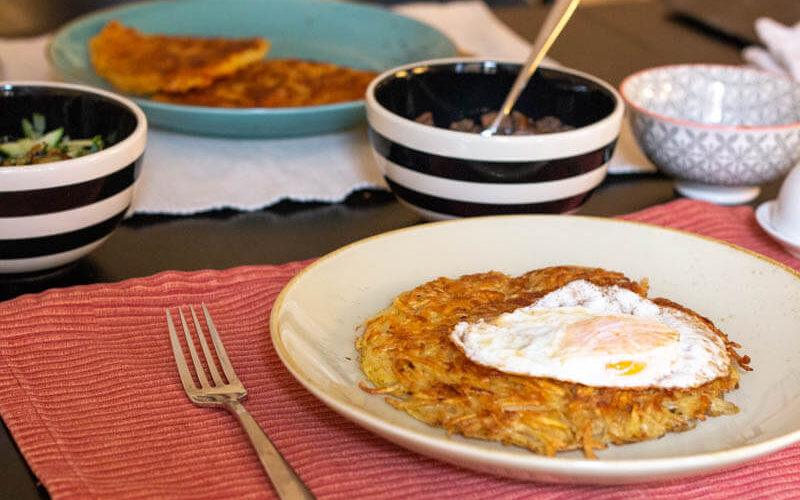
You need to cook a lot of Rösti, especially if it’s meant as the main dish. At a restaurant, you get your own plate-sized Rösti, about 20cm in diameter, as shown below.

I find that a little much for a home-cooked meal. At home, I use 2-3 potatoes per person or about 300-400g per person. I usually serve a half-pan per person, maybe less if I cooked a really thick Rösti and we’re eating it with other food.
At home, I only have one 24cm non-stick pan that works for Rösti. So I have to cook in stages. You can hold a finished Rösti in a warm oven while you cook the next batch, but it’s not quite as crispy when you serve it. If you need to serve more than four people, it can be very time consuming in an average sized kitchen.

What to serve with Rösti
At Swiss mountain huts, Rösti usually comes with a fried egg, bacon/speck, and/or cheese. Some Swiss mix speck or onions inside the Rösti potato mix, but it’s more common to leave the potatoes plain and add toppings instead.

I love when they are generous with the bacon, but always sad when I only get one egg. Many places let you order a second egg, highly recommended. I want plenty of runny yolk to soak into the crispy potatoes. Some have cheese (often raclette) melted over the Rösti. Sometimes the cheese is stirred into the potatoes so the whole Rosti is cheesy. It can taste good but many find it too rich and heavy. I usually wish I had ordered it without cheese.
At Swiss restaurants, Rösti is often served as a side, like with the traditional dish Kalbsgeschnetzeltes, with sliced veal in a cream sauce. It can be side dish with anything that goes well with potatoes. I like to eat it with a mushroom cream sauce and wilted greens. At home, my kids will eat it plain with a sausage, mustard and ketchup.
See more Swiss Family Cooking recipes
Rosti Recipe
The classic hiking food in Switzerland, a traditional dish of fried grated potatoes often topped with a fried egg, bacon and/or cheese, a hearty meal served at many mountain huts in the alps.
Ingredients
- 1 kg potatoes, best
- about 1 tsp salt
- about 100 - 200 g butter or plant-based fat
Instructions
- If you want to pre-boil your potatoes, the day before boil the potatoes (skins on) in salted water for about 20-25 mins. Cool them then place in the fridge until you are ready to make the Rösti.
- Peel the potatoes. If you didn't boil the potatoes, you can skip this step if you don't mind the skins (that's what I do).
- Grate the potatoes on a coarse grater or with a food processor.
- Toss the shredded potatoes with the salt.
- Heat a large non-stick pan over medium heat. Melt a couple tablespoons of butter to the pan. Add the grated potato to the pan, smash down with a spatula and form into a circle.
- (Optional) While it's cooking, occasionally brush melted butter around the sides of the Rösti or rub a pad of butter around the sides so it melts in.
- Let it cook about 8-10 mins, then start checking the underside. When it is golden brown, flip the Rösti using your prefered method. You can slide the Rösti onto a cutting board or plate, then flip it back into the pan. You could set a plate over the Rösti, flip it onto the plate, add more butter to the pan, then slide it into the pan. Whatever works.
- Cook for another 10-12 mins, checking the underside occasionally as you get to the end of the time so the Rösti doesn't burn. When the underside is golden, remove the Rösti from the pan and serve.
Notes
Rösti is often served topped with a fried egg and bacon or with sliced meat in a cream sauce. But you can serve it as a side to any dish that would go well with a side of potatoes.





7 responses
Is it necessary to cover the top while cooking? Thank you!
Hi Amelia, I’ve never covered the top while cooking. But now that you mention it, perhaps that would cook the potatoes faster. You could try it. But I might be concerned about them steaming too much and not getting a super crisp crust on the bottom, which is the important part. Good luck.
We go to Switzerland nearly every year, and I always miss the rösti after going home, so definitely going to try this recipe! Thanks!
This is a super recipe and so well explained. Thanks so much, Tanya! Nous habitons au Lavaux ou nous mangeons beaucoup de rösti.
Thank you very much! Such a nice compliment to receive.
I must have Swiss blood. I have been making “Mary’s potato pancake” like this for years, except plate turning step. I loosen it underneath all around with a spatula, waiting ‘til it’s really crispy on the bottom so it will stay intact when flipped. I put butter on top before I flip it rather than needing to add butter to the pan. I’m amazed at all the steps that I came up with on my own- using the food processor, smashing the potatoes down as they cook with the spatula, lots of butter including dotting butter all around the edge (and on top). I learned one more trick just the other day (America’s Test Kitchen? where I learned this was called Potatoes Roesti): as with french fries, soak the shredded potatoes in cold water, swishing them around to get rid of some of the starch, drain them in a sieve, then wring out in a towel. I always wrung them in a towel but had never soaked them. Yesterday I used German Butterball potatoes and used the soaking step and had my best Mary’s Potato Pancake Rosti ever! Another thing I do differently: my pancake is often thinner, especially after all the smashing, so when it’s really crispy on both sides I can eat it out of hand, tearing off chunks to eat with gusto. I like the idea of loading it up on a plate with cheese and ham and eggs. Or meat and gravy. Must try that! Btw, another tip: the potato water is great for getting a sourdough starter going again. Yeast seem to love potato water.
Thanks for the detailed report and tips! I also prefer a thinner pancake. Keep it up with the fun cooking adventures!