The Klausjagen (or “St. Nicholas Chase”) is a traditional Swiss parade held annually on the eve of St. Nicholas Day (December 5) in the small town of Küssnacht am Rigi on the shores of Lake Lucerne.
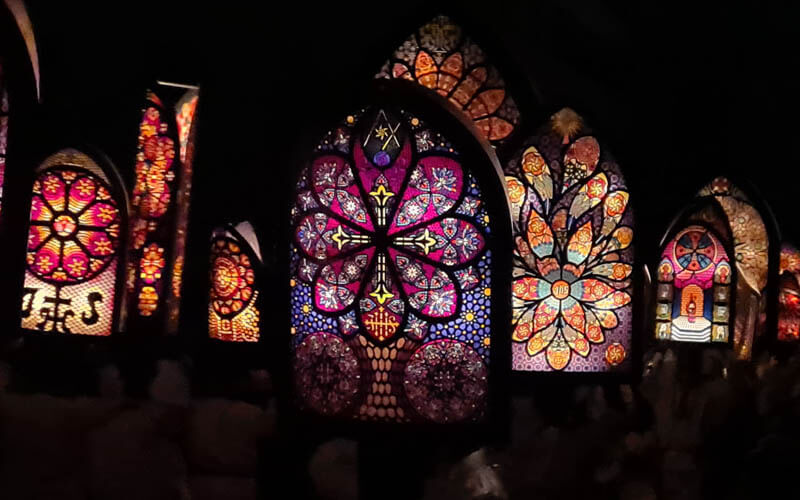
The procession includes two hundred Iffelen, elaborate bishop-shaped headpieces with illuminated intricate designs that resemble stained glass. In addition, hundreds of participants swing large cow bells and crack whips, creating a deafening noise to chase away evil spirits from the dark night.
This unique parade is one of Switzerland’s most special cultural celebrations and definitely worth a visit.
Date: 5 December 2025, parade starts at 20:15
Website: www.klausjagen.ch
Keep reading for info on how to get there, best places on the parade route, and what to expect.
Warning! This parade is extremely loud and noisy and could be very disturbing for small children, babies and anyone with audio sensitivities.
When
This parade usually happens on December 5th , the day before St Nicholas Day. If Dec 5 is a Saturday or Sunday, the parade instead happens on the previous Friday.
The main parade starts at 20:15, going one hour to 21:15. After a 45 min break, it resumes and finishes around 22:40.
There is a children’s parade earlier in the day, from 14:15 to 15:35.
How to get there
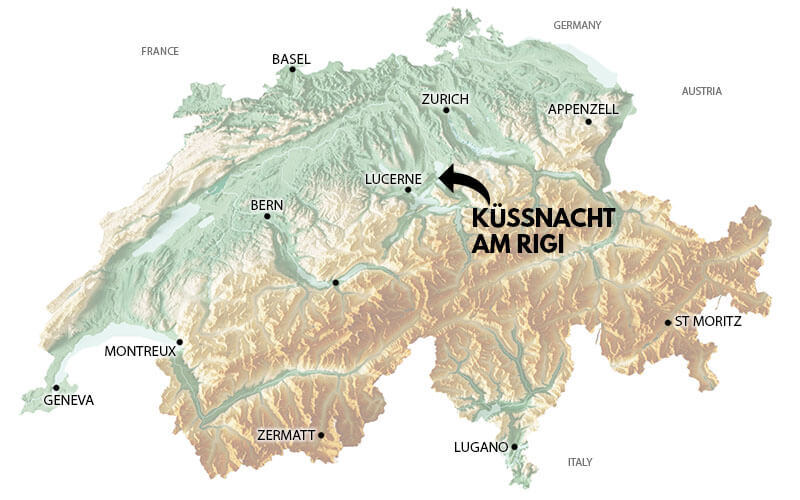
Küssnacht am Rigi is a small town, just east of Lucerne. Since this event attracts up to 30,000 visitors, it’s best to arrive by public transport if possible.
By public transport
The Küssnacht am Rigi train station is about a 5 min walk from the parade route.
Sample travel times:
- Lucerne – 20 mins, direct train Küssnacht am Rigi train station
- Zürich HB – About 1h1. Best connection is train to Rotkreuz, then bus to Küssnacht am Rigi train station.
- Zug – about 30-40 mins. Best connection is train to Rotkreuz, then bus to Küssnacht am Rigi train station.
By boat with fondue
Lake Lucerne offers a special lake cruise to the Klausjagen event, with optional fondue on the boat.
With fondue, you depart Lucerne at 17:45. Without dinner, you depart Lucerne at 18:40. In both cases, you arrive at Küssnacht am Rigi at 19:30, parade starting at 20:15.
After enjoying the parade, the boat departs Küssnacht am Rigi at 21:45 and arrives back at Lucerne at 22:50.
You must reserve in advance. Book Klausjagen boat cruise or boat cruise with fondue.
Note: This special cruise is discounted with Swiss Travel Pass and Swiss Half Fare Card, not free.
By car
If you must drive, we suggest a parking area slightly outside of the village center, since most of those roads are either closed or difficult to reach because of the parade route.
Here are a few parking areas to consider. But note that spaces are limited and may be full by the time you get there.
- Küssnacht am Rigi train station
- Astrid Kapelle parking
- Chli Ebnet parking
- Rigihalle (ice rink) – Oberdorf 71, 6403 Küssnacht
Parade Route
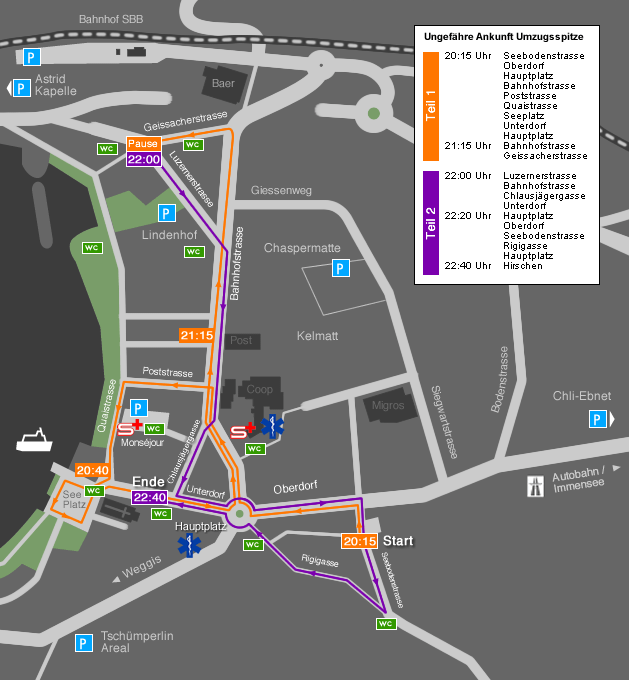
The parade follows a short route through center of the village. It does one loop from 20:15 to 21:15. Then a 45 min break.
Then they go back down the main street, following a similar route for another 40 mins, from 22:00 to 22:40.
You don’t need to see both loops through town.
Where to stand
Like any parade, you can simply stand along the side of the road anywhere along the parade route.
If you want to see the start of the parade and not wait a long time for it to reach you, stand on the Oberdorf street or the Hauptplatz roundabout in the center of the village. This area also has the most attractive buildings in the background.
If you want more room to move, you may prefer to stand in the lakeside park on Quaistrasse.
What to see at the parade
The parade includes four main elements: whips, lanterns, Santa, and cow bells.
Geisslechlöpfer – Whip Crackers
The parade starts with “Geisslechlöpfer,” local farmers that crack their long whips in rhythmic patterns. The whips are very loud and a bit scary, an effective way to clear the streets.
It’s an old pagan custom, where loud noises were believed to scare away evil spirits during the dark winter months. But now typically only done during November and December, particularly to announce the arrival of Samichlaus.
Iffelen – Lantern Hats
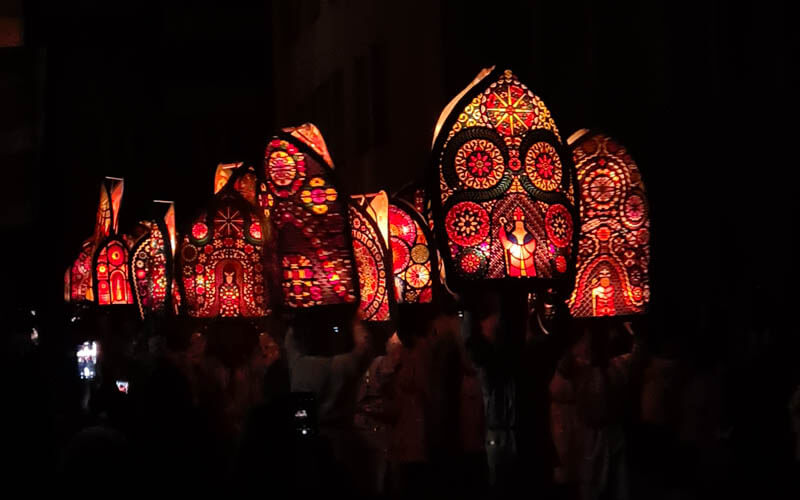
Next come 200 “Iffelen” – large lanterns shaped like a Catholic bishop’s hat, carved with intricate patterns resembling stained glass.
The Iffelen are carried by people dressed in white robes, holding the tall lanterns above their heads and often twirling and bouncing as they walk.
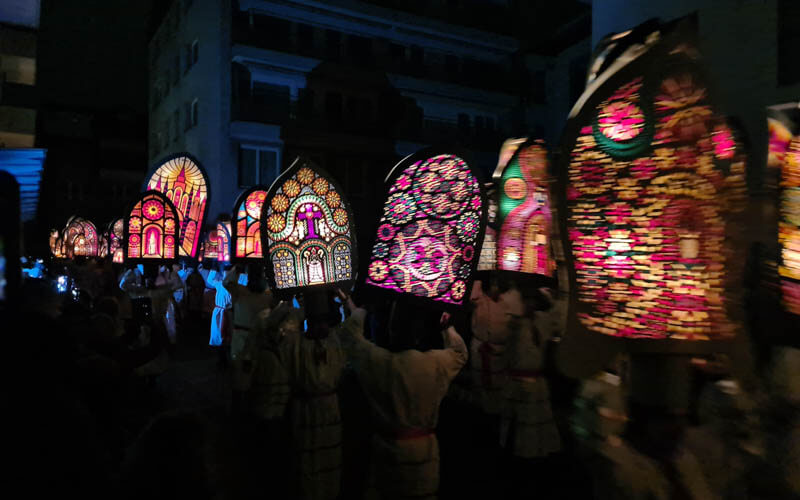
Most Iffelen have the figure St Nicholas on the front, as well as other religious motifs.
It can take over 200 hours to create an Iffele, each one a unique artistic creation by builders keeping this old tradition and craft alive.
Samichlaus
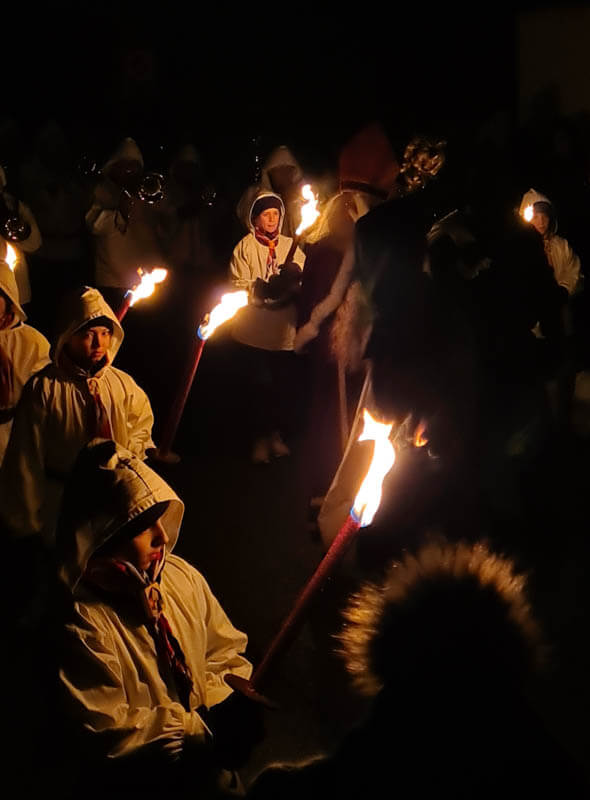
Next comes St. Nicholas (aka Samichlaus), dressed in traditional bishop’s robes. He is accompanied by torchbearers and his helpers (aka “Schmützli”) that hand out treats to children.
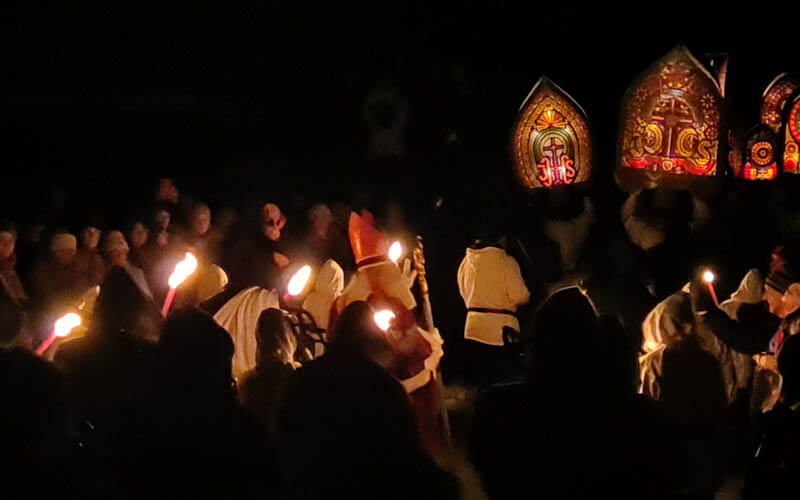
Samiclaus is also followed by a brass band playing a somewhat solemn and repetitive dirge.
Trycheln – cow bells
Lastly, come hundreds of “Klausjäger” (aka Santa chasers) slowing marching as they swing “Trycheln” (large cow bells) in a rhythm, producing a hypnotic, percussive sound that echoes through the town.
Like the whips, the noise is said to symbolically drive away evil spirits and darkness. These bells are used in other Swiss festivals like the Alpabzug (cow descent parades) and Silvesterkläuse (New Year’s Eve).
Food & drink
Before the parade, there are a few refreshment stands set up along the parade route. Most were selling sausages, cakes, soda, beer, and mulled wine.
The lines were quite long and we just barely got ours before the parade started. Unless you plan to arrive at least 30 mins before the parade starts, I’d suggest coming with a full belly and bringing your own drinks.
Historical Context
The exact origins are of the Klausjagen are not well known, but likely originate more 1000 years ago with pagan winter rituals aimed at warding off evil spirits in a wild hunt with loud noise.
More recently, historians think it may also stem from a French boarding school tradition in the Middle Ages, where on St Nicholas day, a boy would be elected bishop and would rule the day. Over time, this day turned into a wild spectacle with increasingly violent behavior.
In 1928, Küssnacht residents started the Klausjagen procession to reign in the chaos while preserving local customs.
See more Swiss Christmas events.