Living in Switzerland for 20+ years, we’ve hiked to a lot of mountain huts in Switzerland, enjoying overnights in special remote alpine locations.
If you’re new to hut hiking in Switzerland, I wrote the guide below to answer all your questions and give you the info and confidence you need to
I’ve included info how to book huts, what to expect at the hut, what to pack, when to go, etc. I’ve also included a few of our favorite hut hikes for beginners to get you started.
When to do a hut-to-hut
For most visitors, the best time for hut-to-hut hiking in Switzerland is July through September.
Most high mountain huts don’t begin their season until late June and snow can remain on the trail well into July. These months give you the widest choice of open huts and generally better trail conditions.

Some lower-elevation huts may open earlier in June or remain open into October. But opening dates can from year to year depending on snow conditions and the hut’s location. Always check the current opening dates and access conditions when planning your hike.
A serviced hut means there is staff is at the hut providing meals, food and water are available for purchase, and common rooms are heated.
Outside the main summer season, some huts remain available as basic shelters, often with a winter room. These generally have no staff and may not provide food, drinking water, or heating. You can usually stay for a fee, but the arrangements vary, so check the hut’s website for its current rules and facilities.
Selecting a hut-to-hut route
If this is your first hut-to-hut hike in Switzerland, I recommend starting with a route that’s been tried and tested rather than choosing huts at random.
See my list of recommended hut-to-hut hikes, including options for different hiking abilities and ways to shorten some routes using mountain transport.
Don’t overcomplicate the planning
You don’t need to become an expert in Swiss hiking maps before your first hut trip. Start with a recommended route that matches your experience.
Once you’ve done a couple hut hikes, you’ll have a much better sense of how far you comfortably hike in a day, how you handle elevation gain and loss, and what type of terrain you enjoy.

Choose routes that match your ability
Be realistic about how much Alpine hiking you can comfortably do in a day. A distance that feels easy on relatively flat trails can be much more demanding in the mountains.
Steep climbs and descents slow your pace, and you’ll likely take more breaks than you would on easier terrain. A hike that looks like 6 hours on the route description can easily become an 8 hour day.
If you’re new to Alpine hiking, build in plenty of time and energy buffer. A shorter route can still give you the full hut-to-hut experience without committing to an exhausting day.
Check the terrain difficulty
Don’t judge a route by distance and elevation alone. Because many mountain huts are in remote locations, the trails leading to them can be rocky, steep, narrow, or exposed.
First, check the trail rating of the trail leading to the hut. For most hikers, best to stick with the standard red-and-white mountain hiking trails (T2). Avoid blue-and-white Alpine hiking trails (T3 and above), which involve much more difficult terrain, including dangerous exposed sections, scrambling, and trails that are difficult to follow.

Next, look for detailed photos, videos, or trip reports of the route before you go. Even a T2 trail can be steep, rocky, narrow, or exposed in places, perhaps with short sections that require a chain for support or a short ladder.
It’s much better to know what you’re getting into before you start than to discover halfway to the hut that the trail is outside your comfort zone.
Planning your own route
If you’d like to plan your own hut-to-hut hike, these are the two resources I use most.
But don’t simply choose two huts that look close together on a map and assume you’ve found an easy hut-to-hut hike. The difficulty of Swiss mountain trails can vary dramatically even over relatively short distances.
SAC Mountain Hut Finder
The Swiss Alpine Club (SAC) operates hundreds of mountain huts throughout Switzerland. You can use its hut directory to see individual huts, their location, opening dates, facilities, and booking information.
SwitzerlandMobility
There are many non-SAC huts in Switzerland, not listed on the SAC website. Many of these private huts appear on Switzerland Mobility, the official hiking network website for Switzerland.
You can use the hiking map to see popular hiking routes to the huts and plan your own routes.
Wayfinding
Mountain trails in Switzerland are usually well-marked, with clear trail markers and trail signs labeled with hut names and other destinations like lakes, mountain passes, and connections to public transport.
But we recommend using a trail app like SwissTopo, SchweizMobil, Komoot or Outdooractive to help you navigate. Using these apps, you can download an offline version of your trail map and use it
Mountain Hut vs. Mountain Hotel
One thing that can be confusing when planning a hut-to-hut hike in Switzerland is the difference between a mountain hut and a mountain hotel or mountain guesthouse. Both can be rustic and located high in the mountains, but the experience can be quite different.
A mountain hut (aka Berghütte) is typically a remote accommodation that you reach on foot. It may be a few hours from the nearest road or gondola, and facilities are necessarily basic. Most guests sleep in shared dormitories, and you are expected to bring your own sleeping bag liner and towel. Meals are generally served in a communal dining room.


A mountain hotel or guesthouse (often called a Berggasthaus) is more like a rustic hotel in the mountains. These are often located near a gondola station, mountain road, or parking area, so they can receive regular deliveries and have better access to laundry, plumbing, and other services.
The example below is the Iffigenalp guesthouse, where linens are provided in the private rooms.
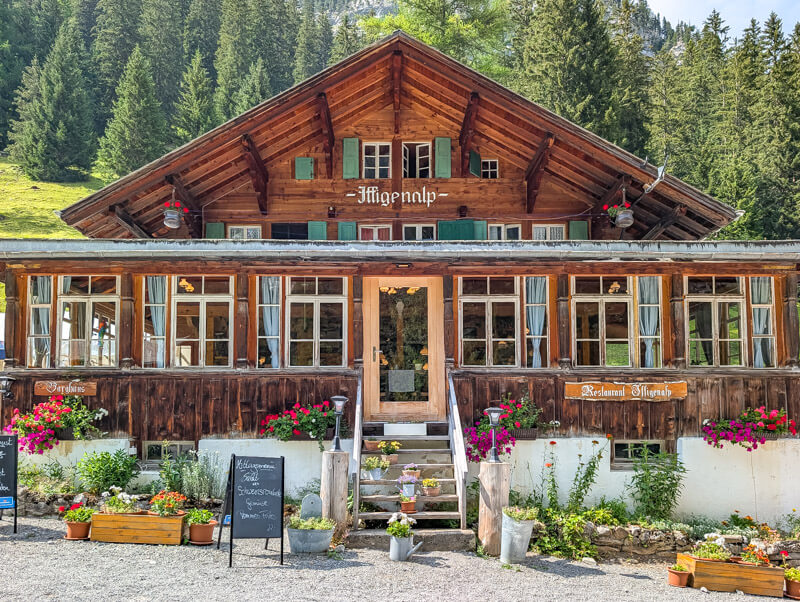
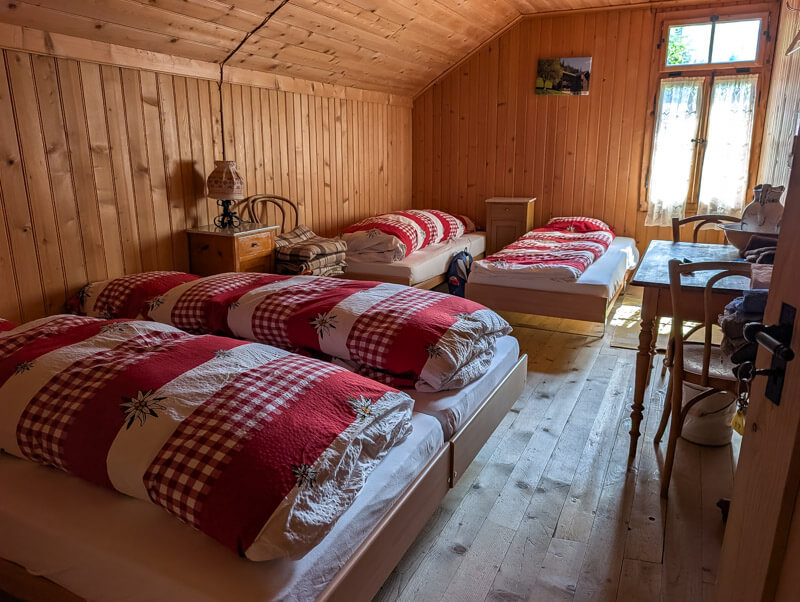
These guesthouses may offer private rooms with proper linens and towels, and some even have private bathrooms. Some mountain hotels also offer dormitory-style rooms, where you need to bring your own sleeping bag liner. Instead of one simple meal for all guests, you can order a la carte off a menu.
For this guide, when I talk about mountain huts, I’m primarily referring to the more remote hut experience. If you’re booking a mountain hotel or guesthouse, always read the accommodation details carefully to see what is included. The type of room you book can make a big difference in what you need to bring.
How to book mountain huts
You should reserve mountain huts in far in advance, especially if you are hiking on a weekend or staying at a popular hut.
When to book
For weekends and popular huts, I recommend booking as soon as reservations open. Many huts open their summer reservations in March or April, although the timing varies by hut.
For weekdays, particularly outside peak summer, you can often find space with only a day or two of advance planning. But don’t count on this for a specific hut or date. If your itinerary depends on staying at a particular hut, book ahead.
How to book
Most SAC huts accept reservations online, which is the easiest way to book. You select your date, number of people and meal option (half-pension or no meal). In some cases, you can book private rooms instead of dorms for an extra fee.
During booking, you usually provide a credit-card to secure the reservation. Then you pay at the hut, often cash only. Check the individual hut’s website so you know what to expect.

Tips for booking several huts
If you’re doing a hut-to-hut hike, you’ll need to reserve each hut separately. As you book each hut, keep track of the cancellation deadline and payment terms for each hut.
Before you book, checking the availability of each hut for your dates. You may need to alter your plans if one or more of the hikes on the route are already booked out.
Cancelling Your Reservation
Cancellation policies vary by hut, so check the policy when you book. Many huts allow you to cancel without a fee up to a day or two time before your stay. But late cancellations and no-shows usually incur a charge to the credit card used for the reservation.
If your plans change because of weather or sickness, don’t simply skip the reservation. Contact the hut as soon as you know you won’t be coming.
What If the Hut Is Full?
For a last-minute trip, you can contact the hut directly to ask whether they have had any cancellations.
Don’t simply show up and hope there is a bed. I’ve seen hikers turned away from full huts in the late afternoon, now facing a long hike to another destination as daylight disappears.
For last minute reservations, you can call the hut to see if there are cancellations.
What to pack
You don’t need much special equipment for hut hiking. But there are a few things you’ll need specifically for staying overnight in a mountain hut.
Sleeping Bag Liner
A sleeping bag liner is required at most Swiss mountain huts. The beds have a fitted sheet, duvet or blanket, and pillow, but the bedding is not changed between every guest. Your liner provides a hygienic layer between you and the hut’s bedding.

If you forget one, some huts sell or rent liners, but don’t count on this. It’s better to bring your own.
The liner can be bought at any sporting good store. In Switzerland, the discount sporting goods store Decathlon sells an inexpensive one for about CHF 15. Otherwise plan to spend CHF 30-50, depending on the material.
Washing up
Bring your normal personal toiletries, but keep them minimal. Huts generally provide hand soap, but don’t expect shampoo or shower gel in the showers.
Huts do not provide towels, so bring your own if you plan to shower. A small, quick-drying travel towel is ideal.
Sleeping comfort
Two small things can make a big difference:
- Ear plugs especially if you’re sharing a dormitory with snorers.
- An eye mask since hut windows often don’t have shades and sunrise comes early in summer.
- Headlamp – helpful at night when visiting the toilet, so you don’t disturb other guests.

Food and Water
You don’t need to carry food for your entire hut-to-hut trip, as huts serve dinner and breakfast, and sell food and drink for a packed lunch.
You should bring a large water bottle that can be refilled. Water policies vary by hut. Some provide free drinking water, while others sell bottled or tap water.
I would also bring some snacks for hiking during the day as these can be more expensive at the huts.
Your normal hiking gear
Apart from the hut-specific items above, pack as you would for any mountain hike:
- Warm layers
- Waterproof jacket and pants
- Hiking boots
- Sun protection
- First-aid supplies
- Hiking poles, if you use them
- Headlamp
- Phone and charging cable
- Personal medications
- Water bottle
What to expect at the hut
Arrival at the hut
When you get to the hut, you’ll enter the mud room where you are expected to remove your hiking shoes and wear the provided house shoes while inside the hut.

There are often places to hiking sticks so you minimize the dirt entering the living spaces. There are sometimes baskets or cubbies for you to store personal food instead of keeping it in your room.
Check-in & payment
Now check in with the staff at the kitchen. Sometimes you have show ID. They will tell you which room and bunks are assigned to. They will tell you when dinner and breakfast will be served.
Typically you pay for bill after dinner, including the overnight fee as well as any snacks and drinks consumed at the hut.
It’s best to pay with cash. Some huts accept TWINT and credit cards, but not all. Check their website for payment options.
Sleeping arrangements
The hut staff assigns you a specific room and sleeping spot. You generally can’t choose your bunk, although staff will usually try to keep groups together. Some huts have private or smaller rooms that you can reserve for an additional fee.
Swiss mountain huts typically have shared sleeping rooms with bunk beds or mattresses. The arrangement varies from hut to hut.
Some have long rows of mattresses where you sleep directly beside other hikers, while others have smaller rooms with individual bunks.

In some huts, a family or group may have a small section of a larger dorm separated by a simple partition, giving you a little more privacy without being a private room.
Your sleeping space will have a mattress with a fitted sheet, pillow with pillowcase, and a duvet or blanket. Use your sleeping bag liner to sleep between yourself and the bedding.
There are usually shelves, hooks, or other open storage areas for your backpack and belongings, but don’t expect lockers. Keep your passport, wallet, phone, and other valuables with you.
Toilets & Showers
All huts have toilets, but it ranges from modern flush toilets to pic toilet in a separate outhouse. Usually there is a sink for washing up, but not necessarily drinking water.
Some huts offer showers, usually for a small fee like CHF 5 for 5 mins of hot water. However, if spring water is running low, the hut may close the showers, which happend to us in late August after a long dry spell.
At huts without showers, you’ll often see people “bathing” at the sinks with washcloths.
Charging devices
Most huts do not have electrical outlets in the rooms. They may have a few sockets in public areas around the hut (like the dining room or hall next to the rooms). But these can quickly fill out as everyone is anxious to charge their devices.
If charging is a priority, I suggest finding a charging port first then when you first arrive, before settling in or showerring. In any case, I would always bring high capacity portable charger.
As a general rule, huts do not provide WiFi and there is usually no connection due to the remote location. Some huts have WiFi for their staff, but do not allow guests to use it.
Lights out
Most huts have lights out at 22:00, with the kitchen closing and quiet time strictly observed. Best to do your bedtime routine around 9pm so you don’t disturb others in your room who have already gone to bed.
Check out
You are expected to pack up all your stuff by 9am and leave the bed in the condition you found it. Fold your blanket and stack it with the pillow in the same manner you found it, ready for the next customer.
Assuming you paid the night before, you don’t have to talk to anyone before you leave.
Food at the huts
Most huts offer “half pension” which includes dinner and breakfast for their overnight guests. If you brought your own food, you can skip these meals and pay only for the overnight (not common).
Drinking water
Don’t assume that the water at a mountain hut is safe to drink. Some huts have potable water, but many do not. Make sure to read the signs near the faucets and fountains.
At huts without potable water, you will have to purchase bottled water, which is expensive since it has to be delivered by helicopter. Often CHF 8-12/liter.
If the hut has potable water, they will sometimes fill your water bottles in their kitchen and maybe provide tap water for free at dinner. Some may have fountains or specific taps that have free drinking water.
In the mornings, most huts provide free Märschentee (aka “hiking tea”) to fill your water bottles for the next day’s hike. They boil spring water to make it drinkable and lightly flavor it with fruit tea. At one hut, we left our bottles on a cart the night before and the next day they were filled with the tea.
Other beverages, like soft drinks, coffee, wine, beer, can be purchased separately from the kitchen any time throughout the day.
Dinner at the hut
Dinner at mountain huts is typically served around 18:30. You will usually be assigned a table and share it with other guests.
If you will arrive late, contact the hut and let them know you are not a no-show. Some huts can arrange a later dinner, but don’t assume this will be possible.
Dinner is generally a communal meal with a set menu, rather than a restaurant where you choose individual dishes. The exact meal varies by hut, but the typical format is similar: you are served a soup and/or salad, followed by the main course and sometimes dessert.
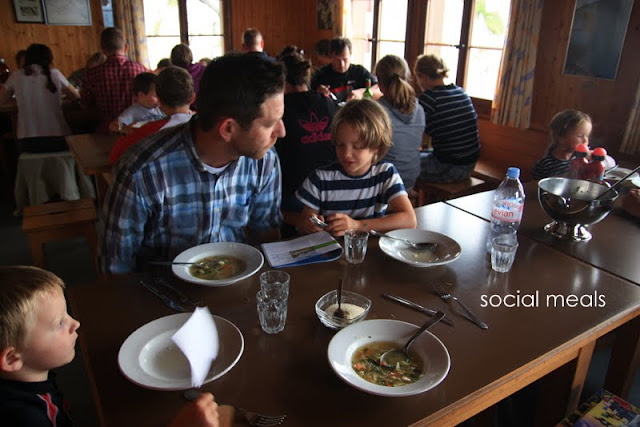
You are usually given one dish and set of cutlery at the beginning of the meal, which you use throughout dinner.
Most huts offer a vegetarian option and sometimes can accommodate other dietary restrictions like gluten or dairy-free. But it’s not a given and you should also indicate your needs in the reservation. Remember that it’s difficult to get the food to the hut and the kitchens are small.
At the end of the meal, you usually clear your own table, bringing everything to the kitchen. At one hut, we stacked all the dishes and the staff cleared everything.
Drinks & snacks
For dinner, you can order drinks separately, which will be put on your tab. Free water is sometimes provided at dinner, but not always.


Huts usually have an assortment of soft drinks, coffee, tea, beer, wine and spirits. Outside meal times, the kitchen usually sells an assortment of snacks, drinks and desserts.
Breakfast
The breakfast buffet is typically available from 7:00-8:00 and you are expect to clear out your bunk by 9am.
At some huts, they also offer an early morning breakfast (4-5 am) for those heading out on long treks.
Breakfast is pretty similar at all the huts. Serve yourself.
- bread, butter and jam
- coffee from a large dispenser, hot water and tea bags, hot milk with Ovomaltine and chocolate powder, sometimes juice.
- sometimes cheese and cold cuts, but only a small amount
- granola or muesli with cold milk and sometimes yogurt

Some huts may bring the drinks to your table, sometimes you have to ask for you want from the kitchen. Just observe what other people are doing and politely follow along.
Packed lunch
If you need food for your next hike, you can often buy sandwiches or lunch pack from the hut. At some huts, you need to order and pay for this the night before.
If you are just passing through, most huts open their restaurant to the public during the day, serving classic mountain food, like cold plates of meat and cheese, a couple hot dishes like pasta or rösti, and cakes.
Other considerations
What if the weather turns sour?
Weather can move in very quickly in the mountains and create unpleasant and dangerous conditions. For example, heavy rain, lightning storms, thick fog with no views, surprise snow. We’ve seen it all.
You may want to plan your tour with a plan B, so you can end the hike earlier, perhaps by hiking out to nearby public transportation if necessary.