The Calanques National Park in southern France is famous for its beautiful narrow inlets surrounded by cliffs and interesting rock formations. It’s a wonderful place for hiking, sunbathing, and boat tours. Here’s what I wish I knew before our trip, plus the details for the hikes and activities we did, and specific tips for traveling with children in this area. I hope this helps in your trip planning.
Important to know first!
The most important thing to know about the Calanques is that during summer, the park is closed to cars and often hikers because of fire risk. So if you want to explore the area by foot, it’s best to visit in early spring or late fall. Thousands of people visit during summer, but mostly explore the region by boat or kayak instead of hiking. More on when to go below.
Overview of the Calanques area
First, here’s a map of the Calanques national park. It is bordered by Marseilles on the west and Cassis on the right, with an bonus section between Cassis and La Ciotat on the far east. We stayed in La Ciotat and spent most of our time in the area near Cassis. If you are based in Marseilles, you will probably spent more time exploring the west side of the park, near Les Goudes and Calllelongue.

What we did
We went in mid-April and did two hikes to the most famous and accessible Calanque inlets, as well as a half-day boat tour from La Ciotat along the Calanques. This was a perfect taster itinerary for our family.
If we had stayed longer, we might have done a kayak tour and maybe a long hike to the less accessible coastline. However, the other hikes in the area were mostly set back from the coastline, without a view of the water, like the pic below. It’s nice, but we came to this region to see the signature coastline, not the interior.

There are cute old towns and touristy seaside resorts in the area to visit, but we weren’t so interested in that as we had already visited Avignon and Arles and on the way here. In the actual Calanques park, I think 3-4 days is just right for a hiking holiday, longer if you want more time just to lounge somewhere with a view.
Which inlets to visit
We visited four inlets, two near Cassis, one in the middle of the park, and one near La Ciotat. Most require a hike through the dusty inland and arriving as a small pebble beach lined with rocky cliffs. There are no services at the beach, no cafes, no water, no WC. Bring everything you need and pack out your trash.
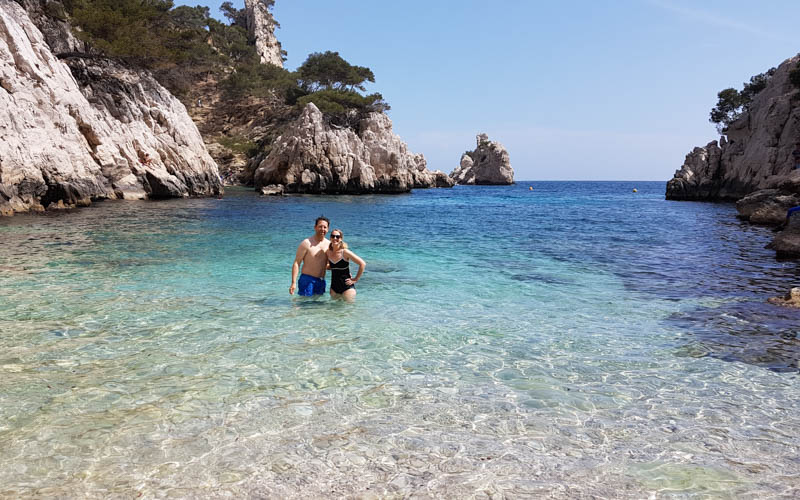
Port Pin. The easiest inlet to access for non-hikers and families with small children is Port Pin. It’s only 1.5 km from the parking and not very strenuous. There is a big pebble beach here with lots of room to spread out and lots of trees for shade. The water is shallow and calm enough for safe splashing and deepens farther out for swimming. Details for this hike here >>>

Calanque d’En-Vau. Continuing on the trail from Port Pin, the trail gets more difficult leading to the inlet of d’En-Vau shown below. Some of the trail is steep with slippery loose rock with big boulders to climb over. So better for older children and those comfortable hiking in such conditions. The trail ends at another pebble beach, but this one lined with steep cliff walls. It’s much prettier than Port Pin, but not less crowded. The trail back skirts along the cliffs above the beach, with the best views of the hike. Details for this hike here >>>

Sugiton. To reach this inlet you first drive to a small town in the middle of the national park, then hike down a dirt road, easy walking, about 3 km to the water. Although the hike itself wasn’t anything special, this was our favorite calanque because the coast had more variety and more to explore. There are two small pebble beaches, which are suitable for children. But most people lounge on the rocks, where you need to be careful not to fall off the edge into the water. This calanque is more open to the ocean, meaning more wind and rougher water in some parts. Details for this hike here >>>

Figuerolles. La Ciotat has their own beautiful calanque, best known for this unique rock formation. It’s very easy to access, no hike, just a few steps from the parking area (though the parking fills up very quickly, you might need to take a bus here). There’s also a cafe with a WC next to the beach. These features are a positive to some, but not for us since we prefer more remote settings. We didn’t spend much time here, just took our pics and left to try something else.

I considered going to Sormiou and Morgiou, but when we saw them from the boat tour, we didn’t think they were as pretty as the others, more like small ports with limited services and some buildings. These appeal more to those not wanting to hike, but drive right to the coast and have a nice meal with a view. But remember, in summer, you probably won’t be able to drive here.
Longer hiking options
I was hoping to do a long hike along the coastline like we had done in Cornwall, using a taxi or bus to return to our starting point. Here is one hiking map of the area that shows a long distance trail.

There were a few problems with this idea. First, this trail is very long and we didn’t have experience hiking with this terrain and climate. So I didn’t know if our kids would be able to handle it.
Also after hiking a bit in this area, I realized the map is a bit misleading. Most of the trail shown on this map is in the interior, behind mountains that block the view on the ocean. Most of the coastline does not have trails near the water because of spiky peaks and cliffs. Rather, the trails are often set back behind the mountains so you don’t have a view of the water. I wasn’t so interested in that.
When to go
Hiking season in the Calanques is October through April. We went in mid-April, when it was just barely hot enough (about 26C) to justify swimming in the icy cold water (about 16C). There were still lots of of tourists, but not overcrowded. Most services and restaurants were open, but it felt a little quiet, with some of the summer tourist attractions still closed. For example most boat tours and kayak rentals were not open yet.
I’ve seen lots of conflicting info about exactly when the Calanques National Park is closed. From what I can tell from the official sites, car traffic in the park is restricted during the day from 1 June through 30 September. Hiking may also be restricted (and often is) during that same time depending on the weather conditions and fire risk. Here are some links where you can check the current status. Some of these are only in French and highly disorganized.
AdLooking for the best online services?
Explore top-rated platforms and secure your discount before it expires.
When we went in April, we were able to drive directly to the trail heads and park in the big metered lots there. I read that during high season, parking is practically impossible.
Boat Tour
A popular way to see the Calanques is by a boat tour, which leave from leave from Cassis, La Ciotat and Marsielles and run all year long. In summer, this is usually the only way to see the Calanques. But even in spring, it was a nice overview to the area.

We wanted to take a smaller boat (12 person) like we did in Corsica, but these only run in high season in the summer. So we went on a large boat that could fit about 100 people. We did the the long tour from La Ciotat to Sormiou and back, stopping at many calanques along the way, including the famous d’En-Vau and Port Pin. Our boat has a glass bottom. In one inlet they slowed down so we could see the fish and the kids loved that!
There are lots of different companies offering tours, all pretty similar in boat style and prices. For example, Les Amis des Calanques does this 2hr30 tour from La Ciotat to Sormiou for €32/pp, €6 reduction for ages 4 to 12, under 4 free.

Kayak tour
We considered doing a kayak tour, which are extremely popular because you can go deeper into the inlets than the boats and stop and explore by foot. But one of our kids got sick so we abandoned this plan. As far as I could tell, you could either do a guided tours or could rent the kayak and go on your own. We saw several big groups in the water and a few families on their own with two and three person kayaks, which would be good when going with kids who might not be able to paddle the whole distance. We saw kayakers in the Calanques near La Ciotat, but I would definitely prefer doing this from Cassis, where the Calanques are prettier and more interesting. In any case, it’s a long paddle on the ocean, which can be very rough with the wind.

There are lots of tour operators, which you can see on Trip Advisor. I called Lokayak to ask about availability and rates and they were helpful and friendly. I’d probably go with them. Kayak Cassis is right in Port Miou at the trailhead for Port Pin, so this would be very convenient.
Where to stay & eat
Cassis is the closest town to the main part of the Calanques. We booked only a few weeks ahead, so we had trouble finding a place in Cassis. Instead we rented an apartment in the next town over in La Ciotat, which is bigger than Cassis, not quite as charming but more services.
La Ciotat is a big port, so lots of boats and a long promenade along the water with cafes and gift shops. The Tourist Information office was semi-helpful with some hiking maps.

La Ciotat has a long city beach, not particularly attractive in my opinion but a good place for kids to run around.

There is an enclosed playground next to the beach.

Where to eat
We ate at one delicious Italian restaurant near the port, De la Vigne à l’Olivier, reservations recommended during high season (44 Quai François Mitterrand, 13600 La Ciotat) The rest of the food we ate was average beach cafe fare, nothing special.
We shopped for groceries at the big Carrefour (Chemin de Virebelle, 13600 La Ciotat). Across the street is a Lidl, Casino Supermarche, bakery and organic specialty grocery, as well as a pharmacy (87 Chemin de la Pépinière, 13600 La Ciotat). There are plenty of other smaller groceries and kiosks scattered through town.
Parking
When looking for a place to stay, make sure it has parking, which is a huge problem in this area. Street parking and parking lots fill up very early in the day. Cassis has parking outside the town and provides a shuttle (for a fee) to the town and the Calanques trailhead. This overflow parking is well-signed and easy to find as you drive into town. Even if you have parking, it may be difficult to access the parking spot because lots of the streets and driveways are very narrow and on hills.
This website shows all parking areas in Cassis. I talk more about this in the individual hiking posts.

A bit of thanks
I found Le Long Weekend blog very helpful in planning this trip. Thanks Nadine!



5 responses
The village has a nice feel but probably quite full and lively during peak season. But then again which place would be quiet during the big holiday season? NONE.
Yes, everywhere on the beach is crowded during summer holidays. If you can, better to go in September.
When you arrive at the car park drive to the southerly end where there is a dead-end road. Follow this road until it gets very narrow and you can see the lake on your right and the sand dunes of the beach on your left. This is a great area to drop the family, as right behind the tiny sand dunes is a great beach area. You do need to turn around and park the car at the main car park but this way you do not have to carry all your beach belongings with you.
The calanque hikes in Marseille are accessible by public transit, which is a real plus. You can also get a bus to Cassis from Marseille, but the return trip can have long lines. Sugiton, Morgiou and Sormiou are all wonderful hikes.
Yes, I’m glad that public transport is an option in that area, especially because parking can be a big problem during high season.