In part 3 of our Swiss public school series, I talk about the apprenticeship system in Switzerland. After secondary school, at about age 15, most Swiss students do an apprenticeship for 3-4 years. During this time, they also go to school part time, studying regular subjects like German, math, sciences, and foreign languages, as well as subjects related specifically to their apprenticeship like business, design or technology. After the apprenticeship, students can look for work or pursue higher education.
In this post, I talk about our experience of my son applying for apprenticeships, including taking the required standardized tests, trial days (aka Schnupperlehre), job search resources, and the application process.
This post accompanies my video series on this same topic, embedded below. After that are important points and links that I mention in the video.
See also Part 1: Prepping for Gymnasium and Part 2: Secondary School & Beyond
Disclaimer: This is not a definite guide to the Swiss public school system or apprenticeships. Information shared here is based on our research and experience in Zürich city public schools, but your experience may vary. Please consult your local school administrators and career counseling centers for the most up-to-date information relevant to your area. Also see the official School overview from Zürich canton (in German) and Berufsberatung website.
I also recommend Going Local: your guide to Swiss schooling by Margaret Oertig, which is particularly helpful if you don’t live in Zürich canton.
Why am I writing about school not hiking?
I usually write about hiking in Switzerland, which is much more fun than school. However, school is a huge part of my children’s lives and we have gathered a lot of information and experience through my son’s 11 years in the public school system. I get questions from a lot of expat parents about this topic, so I thought it would be helpful to share this info here instead of continuing to answer lots of individual emails.
Short Overview of Swiss Public School System
All children go to kindergarten and primary school up to 6th grade. After that, some students split off to an elite academic track called Gymnasium. The rest go to secondary school for 2-3 years until they are about 15 years old. After that, some students take an entrance exam to attend full time school for the next 3-4 year, either Short Gymnasium or one of the “middle schools” which are outlined in Part 2: Secondary School & Beyond.
However, most students get an apprenticeship, where they work part time and go to school part time for the next 3-4 years. After most apprenticeships, they receive an EFZ certificate (kinda like a high school diploma) that indicates they completed the program (work & school), qualifying them to apply for jobs in that career path. They can also pursue a variety of higher education options, including university after fulfilling additional requirements and passing more entrance exams. I explain all this in more detail below.
Pros/Cons of Apprenticeship
Here’s a quick list of pros/cons of apprenticeships, just to set the stage.
Pros:
- gives students practical work experience, making it easier to get a job
- can try out a career before making long term decisions about their education and career
- they get paid, usually about CHF 600-1000/month
- higher education is still an option after the apprenticeship, no doors are closed
Cons:
- getting paid now encourages some students to forgo higher education, perhaps limiting future earning potential
- will take longer to get to university, since students need additional schooling to bridge the gap
- some apprenticeships are not well managed, meaning students may be stuck doing menial tasks, not gaining concrete skills for meaningful future employment
- less vacation than full-time school (5 weeks/year vs 13 weeks)
- some apprenticeships (mostly retail positions) require students to work on weekends
Timeline for Apprenticeship Applications
Before I dive into the details, here’s a brief timeline of what you need to do leading up to an apprenticeship.
1.Sek (7th grade)
- maintain good grades and behavior
- stay in or move up to Sek A
- learn about careers
- Oct – go to Zukunftstag (future day)
- Nov – attend Berufsmesse (career fair)
2. Sek (8th grade) –
- Oct – think about possible careers, ask around for Schnupperlehre
- Nov – attend Berufsmesse (career fair)
- Dec to Jan – take Stellwerk standardized test
- Jan to Mar – apply for Schnupperlehre
- April to June – go to Schupperlehre
- May – take Multicheck standardized test
3.Sek (9th grade) –
- July/August – start applying for apprenticeships (can take months to find one)
- August or October – start prep course for BMS exam
- Jan – sign apprenticeship contract
- Feb – register for school (Berufsschule) and optionally sign up for BMS exam
- March – take BMS exam
- March – no apprenticeship? Find Plan B
- August – start apprenticeship and school
Application process is highly competitive
Most kids will find an apprenticeship eventually. But they may not get their 1st or 2nd choice in which company they want or even in fields. There are a limited amount of apprenticeships, in certain fields maybe only a couple spots in the entire canton. So you have to take this application process very seriously!
You don’t want your child stuck in an apprenticeship that they hate for 4 years. This happens sometimes. You can break the contract and look for a new apprenticeship (I have a couple friends that have done this), but you’ll have to pay a hefty fine and other apprenticeships will not look kindly on this when you apply.
Sek A is important
Secondary schools are usually divided by student performance into 2-3 groups, Sek A/B/C. Sek A is the highest level and is either required or definitely preferred when applying to most apprenticeships. If your child is in Sek B or C, they will not be allowed to apply for certain apprenticeships and will always be passed over for a Sek A student.
If your child is not in Sek A, I recommend doing everything you can to get them moved up to Sek A so they have a better chance when applying for apprenticeships. This may include a tutor, more oversight/micromanaging of their home schedule, frequent meetings with teachers, etc.
It is possible to move up from Sek B to Sek A, however some teachers and schools make it harder than it should be. The first challenge is that Sek B moves slower, so the longer your child is in Sek B, the farther behind they will be and the harder it will be for them to catch up.
The second challenge is that some teachers pigeon hole kids as “Sek B” kids and constantly resist any requests or efforts to move those kids up. If you want to move your kid up, meet with the teacher often (every 3 months minimum) and involve the school principal if necessary. Set goals with your child and teacher (for grades and/or tests) so there are objective results that you can point to when making the argument to move your child up a level.
For more on secondary school and particularly Sek A/B, see Part 2: Secondary School & Beyond.
Grades & Behavior Matter
When you apply for an apprenticeship, you usually send copies of your report cards (aka Zeugnis) from all years in secondary school. So even if your child improved over the years, if their desired field is very competitive, lower grades in 1.Sek may count against them.
Also report cards include behavior rating like are they respectful, punctual, motivated, work well with others, etc. The scale in Zürich is: Very Good, Good, Average, and Unsatisfactory.
I spoke with a Sek B teacher who said students with any check in the Unsatisfactory category or more than one in the Average category may have trouble getting interviews. She had a couple students that weren’t getting called back for any interviews. So she called one of the companies to ask for feedback so she could help the students. The company said they will not accept any student with an Unsatisfactory mark for behavior, even if that was only in 1.Sek. This teacher said she tries to not give a rating below Good unless it is really warranted because she knows the effect it can have on their future. But not all teachers are so thoughful.
So if your child was in Sek B or had behavior problems in the first year, that could affect their chances for competitive apprenticeships.
Standardized Tests
Most applications require that you submit test results from two standardized tests: Stellwerk and Multicheck / Basischeck (depends on which type of apprenticeship you apply for). About 30,000 kids take these tests every year!
There is some controversy about these tests. Some companies find these helpful because school grades can be quite subjective and vary widely between schools and teachers. Some complain that these tests only evaluate a student’s performance on one specific day and doesn’t represent the student as a whole. I found a couple interesting articles on this topic (German only).
- KMFV Blog – Monopol Multicheck
- SRF – Multicheck: Testresultate sind doch einsehbar
Some apprenticeships require a specific minimum score on these tests to apply. This score varies depending on what apprenticeship you apply for. For example, a Kaufmann (sales person) might need a 400 in math and 600 in German, but IT might need 600 in Math and 400 in German. The JobSkills.ch website shows the ideal test scores for each job category.
Stellwerk test
Stellwerk is a free standardized test that kids take in school, usually sometime in Dec-Jan of 2.Sek (8th grade). Teachers do not specifically help students prep for this test in school. You can only take it once. We weren’t even notified until after the fact. It includes Math, German (including an essay), French, English, and Natur und Technik (can include chemistry, physics, biologie).
You can get complete info about Stellwerk and see sample tests on their website.
Here is a sample Stellwerk test result. This is not an absolute score. This is the percentile that you fall into compared to other students taking this test.
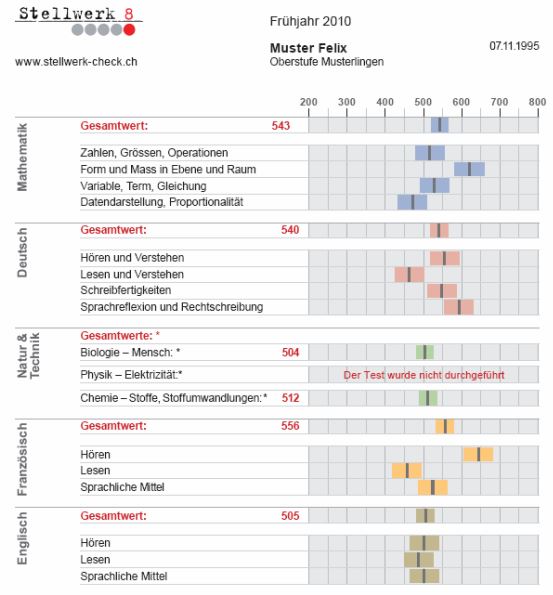
This chart is submitted as part of your apprenticeship application.
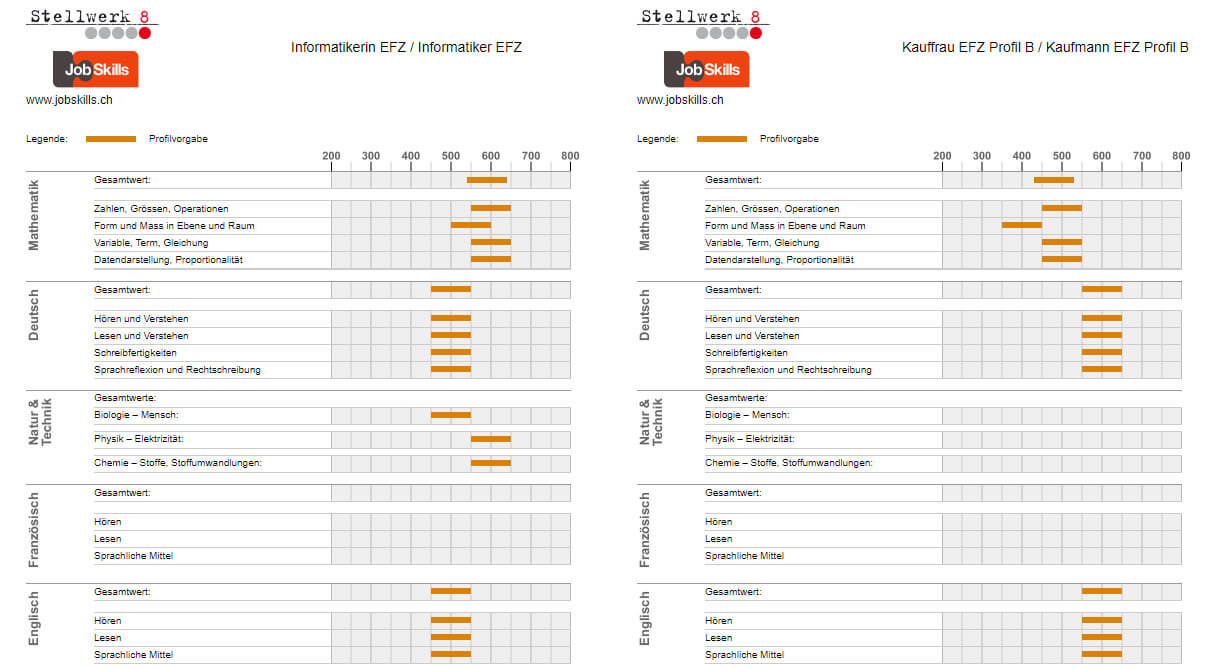
Each job has an ideal Stellwerk profile, as shown on JobSkills.ch. You can select your desired career and see the Stellwerk scores “required” to get a job in that field. This page is fascinating! You click on a career on the right and you see the ideal Stellwerk scores on the left. The example below shows the ideal profile for an IT Professional (left) and for a Sales Person (right).
Multicheck / Basischeck test
Multicheck & Basischeck are aptitude tests that many apprenticeship applications require. You must pay for this test privately (CHF 100) and take it at one of the official testing centers. The test is given on a computer so you can’t jump around the test answering ones you know first. You have to answer questions in order.
See the Multicheck website for complete info about this test. Here’s the short version.
When you sign up for Multicheck, you must also select the version of the test that matches your apprenticeship field. Basischeck is another version of this test, not specific to a career field. One teacher told me this is mostly for unskilled labor apprenticeships. You probably won’t need this as most apprenticeships require Multicheck.
The list below shows the Multicheck categories. To determine the correct category, you look at this list of careers on their website, which tells you the correct category.
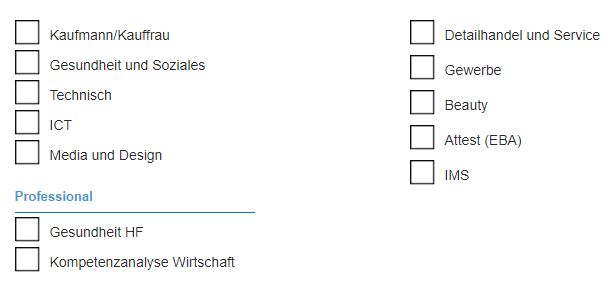
What’s on the test. Multicheck tests Math, German, French, English but also logic, concentration, short-term memory, retention and connected thinking. It also test skills that are specific to the career. My son took the ICT Informatiker version of the test that included imagination, organizational capacity and IT knowledge.
Test results. The scores from the test are a little difficult to understand. You don’t get an absolute score of how many questions you answered correctly. They do some complex calculations and place you in a percentile for each topic, showing how your child did compared to everyone else who took the test. This PDF from Multicheck (in German) explaining everything about the test, from what’s on the test to how they calculate the test results.
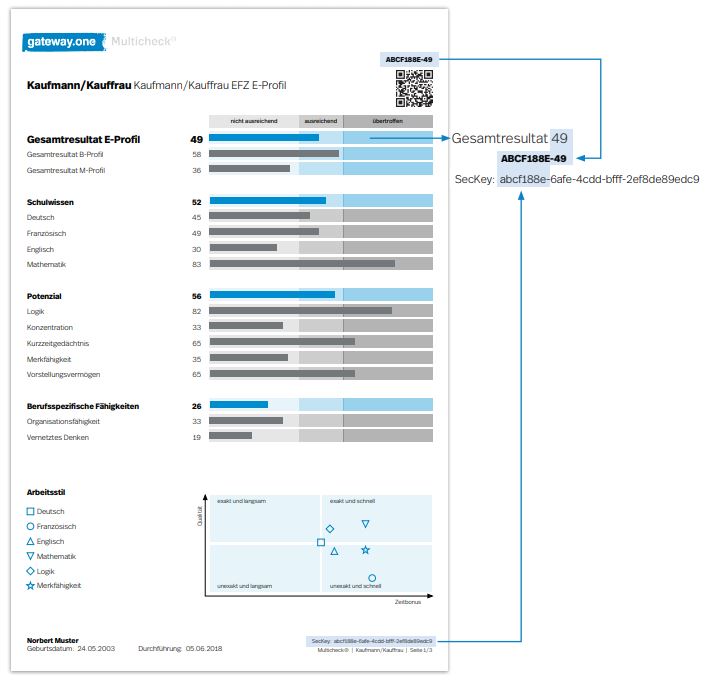
The following sample test result is from the Multicheck website. You can see that you get a percentile score in each category and over score (Gesamtresultat). In general, you need at least an overall score over 40 to apply for anything. A score between 40-60 is typical. The Multicheck staff told me that anything over 60 is a very good score.
Also note the graph in the lower right that shows topics rated for preciseness and speed. The test is timed and you get more points based on how quickly you answer correctly. So if you answer many questions correctly but slowly, you may do poorly on the test overall.
You can take it a second time (and pay another CHF 100), but your scores from the previous test will be included with the test results. So you can’t hide the first test results from your application. The testing period resets every year in May, so you can take the test again after May and your previous scores are erased.
Prepping for Multicheck. They offer sample tests on their website, which you should absolutely practice with, especially getting used to the timing factor. Private companies offer prep courses for this exam, but when I talked to the Multicheck staff, they recommended against the prep courses saying that they are ineffective and don’t really prep you for the types of things they test. They frequently get complaints from parents that paid for these prep courses, but their kids didn’t do well on the tests.
Schnupper – Trial Apprenticeships
Before applying for an apprenticeship, students typically do one or more “Schnupperlehre” or job trials. This is an opportunity to test out the job and see if you would like to do that for next 3-4 years. There is lots of info about Schnupperlehre on berufsberatung.ch.
Any student over 13 years old can Schnupper. These are typically done during spring break. But some companies can’t do that so your child may need to take Joker days from school to do a Schnupper. Some schools give kids a week off just to Schnupper. You need to know what the policy is at your school before applying.
There are three kinds of Schnuppers that all involve visiting a company. But what you do at the visit may vary widely based on the job field and company size.
Schnupperbesuch – You visit a company for one day. This is usually more observational and informational, not active. My son did one of these at a bank, where 30 kids were invited to a 1.5 day event, with a variety of presentations and activities hosted by the team that manages the apprenticeships.
Schnupperlehre for Career Choice – You spend 2-5 days at the company, usually shadowing employees and performing tasks yourself. They might give you a skills test. They are judging you as much as you are judging them. At the end of the visit, they send a report of what they thought you. If they like you, they might invite you to apply for an apprenticeship there.
My son did one of these as a smaller company where he was one of 6 kids. They were given a bunch of tasks and tests to perform over the 2 days to see if they would like the work and be a good fit. They didn’t shadow employees.
Schnupperlehre for Apprenticeship Application – As part of the apprenticeship application process, some companies require that you do a 5 day trial to see if they like you. These Schnuppers are more intense, involving lots of hands-on work and possibly skills tests. These are often done in the fall, after the company has interviewed applicants and selected a smaller pool for this final selection process.
Applying for Schnuppers & Apprenticeships
The process is basically the same for applying for Schnupperlehre and Lehrestelle. You search for open positions then submit an application with a cover letter, your grades for Sek and test results. For Schnuppers, you send the Stellwerk test results. For apprenticeships, you send both Stellwerk and Multicheck.
Many companies advertise both Schnupperlehre and Lehrestelle positions through Yousty.ch, which currently has 13000+ Schnupperlehre and 15000+ Lehrstelle available. Through this website, you can often apply online, uploading digital copies of the required documents. Some companies list available on their website. Other companies, mostly small businesses, don’t advertise and you have to call them personally to ask.
In secondary school, teachers typically teach the skills necessary for this application process, including writing cover letters (with sample templates) and practicing interviewing skills. My son’s career counselor encouraged students to call the companies directly, even if they had online application forms. It gets better results apparently.
In my son’s case, he applied for about 10 Schnuppers and was invited to three. We could have put more effort into this, but at the time, I didn’t really understand how important Schnuppers can be to getting an apprenticeship.
After the Schnuppers, he applied for about 10 Lehrstelle, including two of the companies where he did the Schnuppers. He was invited for an interview at both of those companies and one other.
Berufsschule, aka Vocational School
During the apprenticeship, students to go part-time school, studying subjects like German, math, sciences, foreign languages, etc as well as subjects related specifically to their apprenticeship like business, design, health sciences or technology.
There are lots of different Berufschule in Zürich canton, each focusing on a few vocations. Here is a list of Berufsschule in Zürich canton.
Your apprenticeship determines which school you will go to and they will tell you where you need to register. For example, if you are studying design, you will probably to go to Schule für Gestaltung or if you have an apprenticeship as a dental technician, you will probably go to Allegemine Berufsschule Zürich. Every school is organized differently. Some have you go two days a week. Others have you work three weeks, then go to school for one week.
This school is considered part of your apprenticeship experience and is required.
BMS, Berufsmaturtitätschule – aka Vocational School Matura
Students can optionally add BMS (Berufsmaturitätschule) to their school experience, which qualifies students for higher education after the apprenticeship.
Official detailed info about BMS (in German).
Honestly, I haven’t been able to get a straight answer about what the difference is between regular Berufschule and BMS classes. Maybe the classes are more difficult or they study additional subjects. I’ll still looking into this.
But the important thing is that if they complete BMS, students receive a Matura, a higher level of academic achievement that qualifies them for higher education. While a Gymi Matura allows students direct entrance to university, BMS allows students direct entrance into a Fachhochschule, which is higher education specific to their field of study.
Interestingly, students going to IMS (Informatik Mittelschule) also get a Berufsmatura. So students doing an IT apprenticeship and students going to IMS school come out with the same qualifications.
If students don’t do BMS during the apprenticeship, they can do it after the apprenticeship, full time for 1 year or part time for 2 years while they continue to work. After that, they can apply to a Fachhochschule.
To go to BMS, students must pass an entrance exam, similar to the Gymnasium entrance exam, but not as difficult. As of 2019, it includes German, French, English and Math. You can take private prep courses to prepare for it, same as for Gymnasium. My son took a prep course (3hrs a week for 18 weeks) and happily passed the BMS exam.
This exam is held in early March. You must sign up for it at the school where your child plans to attend. You have to take the version of the BMS that is specific to the vocation they are pursuing with the apprenticeship.
I’ve heard that BMS is a ton of work and lots of students drop it after the first year because they just can’t keep up with the apprenticeship work schedule, regular school and the additional BMS work. I’ll report back after my son has some experience with this and let you know what we think.
School after apprenticeship
Here are typical paths post-apprentices take:
- continue working at the company where they did the apprenticeship (if the company offers that)
- look for a different job in that same vocation
- look for a second apprenticeship in different vocation
- work part time and pursue higher education part time – Fachhochschule or University
- pursue higher education full time – Fachhochschule or University
As I mentioned above, after 3 or 4 years an apprenticeship, students leave with an EFZ certificate, which certifies they completed their apprenticeship and vocational school and have a minimum level of skills in that vocation. With this certificate, they can continue working at the same company or apply for work elsewhere in the same vocation.
Many also choose to pursue higher education, either part time while working or full time. Many apprentices go to a Fachhochschule, which is higher education specific to their chosen career path. If you already have the Berufsmatura, you can apply directly. If not, you’ll need to go to BMS school first as I mentioned above.
Students that did an apprenticeship can also go to university. But they must first do a Passerelle, more pre-requisite education, before you can apply to university. You have to pass an entrance exam to do the Passerelle.
I don’t know much about Fachhochschule, Passerelle or University because we haven’t got there yet. But I’ll report back when I do.
University outside Switzerland
Some expats want their children to attend university in their home country. Since the systems are so different, there is no one answer to how you can apply to a university outside Switzerland. You should contact the desired university directly and ask about the application process and prerequisites for international applicants.
In most cases, the student’s grades and completion certificates (like a Matura or EFZ) have to be sent to a translation and accreditation agency. The university will tell you which agencies they work with.
I’ve heard that some American universities accept the EFZ as a high school diploma. So you don’t necessarily have to go to gymnasium to apply to a U.S. university.
Students may also need to take a language certification test, like Cambridge English Exam, even if it’s their mother tongue. I was happy to learn that my son’s apprenticeship encourages and pays for French and English language certification exams.
The end, for now
That was a long post! I’m exhausted. I don’t have all the answers, but hopefully this points you in the right direction. I’d love to hear about your experience, so leave a comment.




14 responses
So much information to take in. My son has been top of his class since reception in most subjects in international school in Spain, we are now moving to Switzerland and I am worried he will be left behind because he does not speak German..yet. He is starting in year 6 in August and doing an integration class for 12 weeks. I don’t think I will put the pressure on him to even try the gymnasium route and will go apprenticeship – higher education way. Fingers crossed. I will keep an eye out for your next video on how your son is doing.. Thank you so much.
Our son will be 16/17 when we move to Switzerland and is special needs (dyslexia and ADHD). He is currently in a similar type of apprenticeship program (part days school/part days internship). He is bilingual English and French but no German. Will he have access to German immersion as a new immigrant? Are there apprenticeship opportunities for those with special needs? If not (as it sounds like apprenticeships are highly competitive), what would be his options? Thank you for any advice. We are worried he will not find a path to success in such a competitive environment.
Hi Catherine, your son’s age is a difficult age to start in the Swiss school system. Most teens at this age are finished with obligatory school and are in apprenticeships, gymnasium, or similar program. So the public school system is not really offering services for kids this age, and certainly not immersion programs (those are offered at primary and second school levels). I think private school would be the only option in his case. You might contact https://swisseducationconsulting.ch/ for advice.
Thank you! This article was extremely insightful. I have 4 children in the Swiss school system and I must say that it is a very classists system. It is unfortunate that children need to decide their entire future at such a young age with the constant changing of jobs and the technology happening so quickly. Thanks again
The most useful article I have found to give an overview on all these topics – we are in the midst of 2Sek and its an absolute minefield with all this apprenticeship-seeking, and I really feel the Auslander-disadvantage!
Good luck! My oldest is finishing his 4yr apprenticeship this summer and my youngest starts his in August. I’m so relieved that Sek is almost over and the Lehre application process is done. I hope things get better for you and your child.
Hi,
Thank you for sharing, very helpful.
A doughter of a friend, currently in the 10th school year after finishing Sek. A. She is trying to get an apprenticeship, but no haven’t got any until now.
What should she do?
I would set an appointment with BIZ to discuss the options which are many: https://www.berufsberatung.ch/
Thanks for this! Been here for a while and dealt with a lot of school issues, but Sek and Lehres are uncharted territory. Great to get this overview! Thank you!
Glad I could help. Wishing you luck in this difficult part of the school process.
“look for a second apprenticeship in different vocation” I don’t know anyone who did this. Most people work after their apprenticeship and try to gain another education after they got some work experience.
Berufsmatura (BMS 1): A apprentice who would normally go to school once a week, goes twice a week. At the end they get the matura, but they also get the EFZ and have work experience.
BMS 2. After students finish their apprenticeship, they can either work part time for two years and go to school once a week (gather more work experience and get an income) or they go to school full time for one year (no work experience and no income).
In the vocational school (and in other schools) I was the best student in my class. Everyone believed I went to Sek A and had awesome grades. All the teachers asked me, why I didn’t go to the Gymi. No one believed me when I told them, that I was in Sek B with bad (passing) grades (my worst grade was in geometry with a 2.5). I just wasn’t interested at the time. Only later in life I learned how to learn.
Being in Sek B doesn’t mean you are cursed for the rest of your live! But the students really have to look at as many professions (Schnupperlehre) as possible.
Thank you for this important perspective. I agree that Sek B is not an “end of the road” but it can make things much harder than necessary. I’m glad that you were able to overcome that shaky start and have success. I just have friends with kids in Sek B that have had a lot of trouble finding Lehres in their desired Beruf because Sek B isn’t considered good enough for those Berufs. So if possible, it’s certainly an easier road if you can get into Sek A.
Thorough and extremely useful article on the swiss system, a good source of information for many people, and will be much appreciated, thanks and good luck with the boys!
Thank you so much for taking the time to write and share this. It is great to have an overview in English. I shall be studying the whole article a d clicking on all the links 🙂